
Picture an arch so deep in the earth that it sits 450 metres under the ground, hidden inside billion-year-old bedrock, where tunnels stretch for kilometres. Inside, thousands of canisters of spent uranium fuel will be sealed away, material that will remain hazardous for more than 1,00,000 years. This isn’t the assumption of any dystopian novel – it’s the truth, the reality of Finland’s Onkalo nuclear waste site, the world’s first permanent deep geological repository.
Built by Posiva Oy, a company owned and maintained by Finland’s nuclear utilities, Onkalo represents a daring attempt to answer one of humanity’s hardest questions: how do you securely store nuclear waste for longer than civilization itself has existed?

A Silent Tomb Beneath Finland
Onkalo is located on Olkiluoto Island, which is home to Finland’s most critical nuclear power plants. Excavation started in the early 2000s, and the underground maze now contains more than 10 kilometres of tunnels, with plans to enlarge it to about 50 kilometres during the operational phase. The repository itself lies between 400 and 430 metres underground, cut into a bedrock formation that is roughly around 1.8 to 2.0 billion years old.
The site is vast – it covers about two square kilometres, and the rock dug out from the project totals nearly two million cubic metres. According to Posiva, the facility is designed to hold approximately 6,500 tonnes of uranium fuel, loaded into about 3,250 copper canisters.
Unlike temporary waste pools or dry-cask storage, which are at reactor sites, Onkalo is something that is meant to last. The target lifespan is around 1,00,000 years, as accounted by science. That means it is being built to remain firm through future ice ages, geological shifts, and countless human generations.
Also Read: Nuclear Waste Is Reusable; So Why Aren’t We Using It?
Why Finland’s Onkalo Nuclear Waste Site Is Being Built and What Makes It Special
- Finland produces roughly a third of its electricity from nuclear energy, mainly from the Olkiluoto Nuclear Power Plant and Loviisa reactors. This gives rise to high-level spent fuel that cannot remain safely above ground for more than a few decades. That need gave birth to Onkalo.
- The repository depends on the KBS-3 method, which was first developed in Sweden by SKB. The waste will be placed in copper canisters, surrounded by bentonite clay, and then packed in stable crystalline bedrock. Each layer is designed to serve as a barrier to prevent corrosion, water intrusion, or radioactive leakage.
- The geology of Olkiluoto makes it exceptional. The bedrock is among the oldest and firmest on the planet, with little seismic activity as compared to countries like Japan or the U.S. That firmness is one of the reasons why the International Atomic Energy Agency (IAEA) has often cited Finland’s repository as a model for other nations.
- Onkalo is a long-term project. Operations are expected to carry on for about 100-120 years, meaning waste disposal will last until around 2120. After that, the site will be permanently sealed, and surface facilities will pull apart, leaving only a “silent tomb” beneath the rock.
- The financial commitment is immense. NS Energy documents that total costs, including construction, operation, and closure, are projected at more than €2.5 billion.
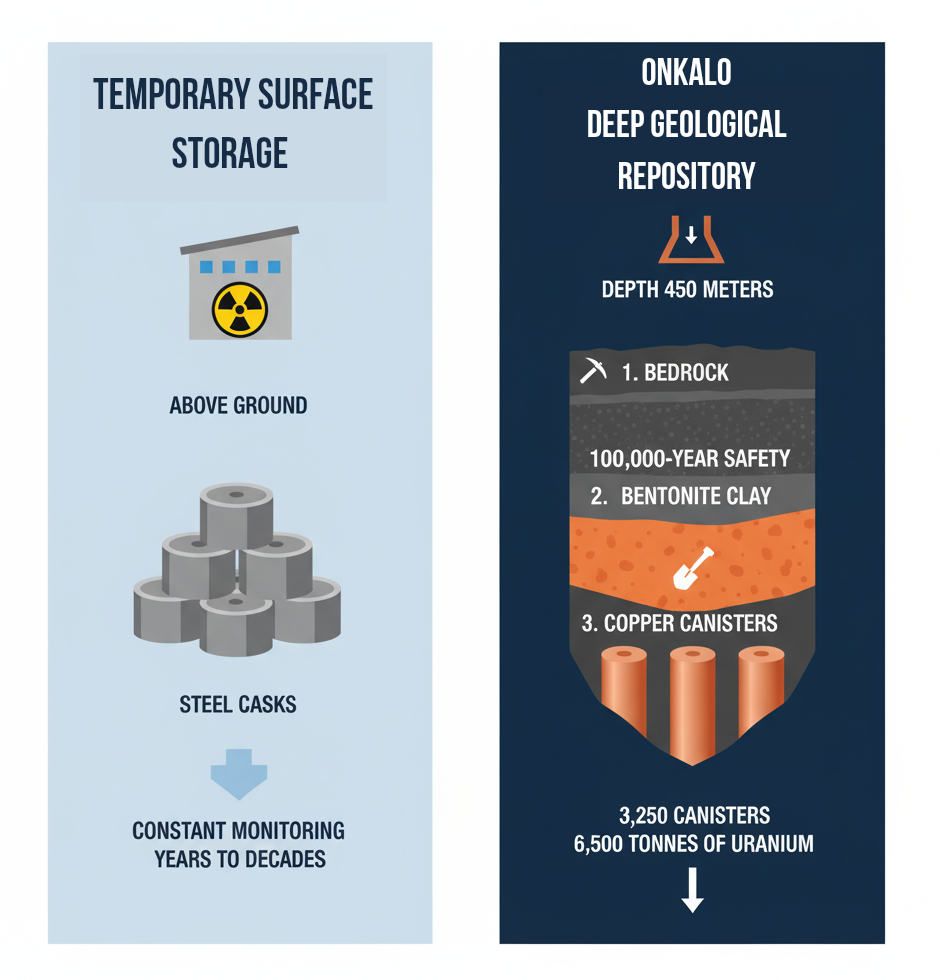
Temporary Storage vs. Onkalo
Feature |
Temporary Storage |
Onkalo Permanent Repository |
|---|---|---|
| Depth underground | At or near surface (pools, dry-casks at reactor sites) | Approx. 400-450 metres deep in stable Finnish bedrock |
| Duration of safety guarantee | Decades to a few centuries | Designed for (approx.) 1,00,000 years |
| Safety system | Steel/concrete casks, often with minimal geological protection | Multi-barrier: copper canisters, bentonite clay, bedrock |
| Capacity | Limited by plant infrastructure | Around 6,500 tonnes of uranium, or around 3,250 canisters |
| Risk of leakage | Higher, especially with ageing facilities | Very low, designed for groundwater stability and even future ice ages |
| Lifecycle cost | Lower upfront, requires indefinite maintenance | More than €2.5 billion, but the closure ends the need for active upkeep |
Also Read: Nuclear Reactors And Climate Change: Can They Really Save Us?
Risks, Ethical Dilemmas, and What Could Still Go Wrong
- Even if the geology is stable, the future holds a big question mark. BBC Future has pointed out that advancing ice sheets, several kilometres thick, could crush and move the land during future ice ages, creating seismic risks.
- The copper canisters, central to the design, are not lacking controversy. Researchers like Peter Szakálos of the Royal Institute of Technology in Stockholm have argued that copper may corrode even in oxygen-free conditions. If true, this could reduce the lifespan of the canisters dramatically.
- Another crucial concern is water intrusion. If groundwater penetrates deep enough, it could corrode canisters or alter the chemistry of the bentonite clay buffer. Although STUK, Finland’s nuclear regulator, has tested many scenarios showing exposure risks remain below international safety limits, critics argue that a margin of uncertainty will always exist.
- There is also the problem of human memory. Thousands of years from now, future societies may neglect what lies beneath Olkiluoto and dig into it, seeking resources or land. Warning markers are being debated, but communicating “danger” across 50,000 years is one of the most difficult design challenges.
- Morally, burying waste gives rise to many questions about fairness. Some philosophers argue that sealing waste underground is essentially transferring the burden onto future generations. Others counter that leaving it in temporary surface storage is far riskier, as facilities degrade over centuries.
Also Read: The Mind-Blowing Thing We All Get Wrong About Energy
What the World Can Learn from Finland’s Onkalo?
Globally, nuclear waste has gathered at reactor sites for decades. Projects like the Yucca Mountain Project in the United States were rejected due to political opposition. France, Canada, and Sweden continue to debate their options. But Finland pressed ahead, acquiring public trust through decades of open dialogue and careful site selection.
The country’s plan shows that figuring out the nuclear waste problem requires more than engineering. It demands public engagement, transparency, and long-term political commitment. Onkalo’s methods, especially the KBS-3 disposal method, are now influencing standards internationally. Furthermore, for Finland, Onkalo is not just a technical project – it is a philosophical statement. It asks us to think beyond our own lives, to design something that must endure through ice ages, civilizations rising and falling, and languages that may no longer exist.
In that sense, Finland’s Onkalo nuclear waste site is as much a monument to human foresight as it is a tomb for radioactive waste.
Also Read: Is Earth’s Core Energy The Key To Meeting Global Energy Needs?
Frequently Asked Questions (FAQs)
Q1. Why is Finland’s Onkalo nuclear waste site considered “unique” in the world?
It is the very first fully operational deep geological repository for civilian high-level nuclear waste. While some other nations, like Sweden and Canada, have proposals, Finland has shifted from design to construction to near-operation, making it a global pioneer.
Q2. How long will nuclear waste stored at Onkalo remain dangerous?
Some isotopes remain highly radioactive for thousands of years, and certain materials stay dangerous for up to 1,00,000 years. Onkalo’s design is meant to isolate the waste for that entire period.
Q3. Can Onkalo guarantee absolute safety and security for future generations?
No. There’s no facility that can promise absolute safety over geological time. However, Finland’s multi-barrier system, geological stability, and regulatory oversight make the chances of harmful leakage extremely low as compared to interim storage options.
Also Read: Power-Sector Emissions In India Fell Again, Marking First Multi-Decade Reduction

0 Comments