
China’s space solar farm is a monumental initiative. Aerospace engineer Long Lehao compares it to moving the Three Gorges Dam, the world’s largest hydroelectric power generator at 2,335 meters long, to a geostationary orbit 36,000 kilometers above Earth. Positioned in a geostationary orbit, the solar farm will remain fixed over one spot on Earth’s surface, ensuring continuous energy harvesting without interruptions from daylight or seasonal fluctuations. This location is crucial for maximizing solar energy collection, as it avoids atmospheric interference and weather-related disruptions.
The project’s scale is emphasized by its anticipated width of one kilometer, making it a significant engineering feat. Construction began in Chongqing in 2019, as reported by Global Construction Review, highlighting China’s commitment to advancing space-based renewable energy. This initiative is part of China’s broader strategy to lead in sustainable energy, aligning with global efforts to combat climate change and meet increasing energy demands.
Unparalleled Energy Harvesting Potential
Space-based photovoltaics are estimated to be approximately ten times more powerful than terrestrial solar arrays, capable of continuous power generation due to their position above Earth’s atmosphere. According to Sustainability Magazine, the solar farm is predicted to generate as much energy each year as all the oil extracted from the planet in the same timeframe, underscoring its potential to revolutionize the global energy supply. The energy will be transmitted back to Earth using microwave technology, a method that has been tested and is considered safe for human and environmental exposure, as noted in discussions on space solar power technologies.
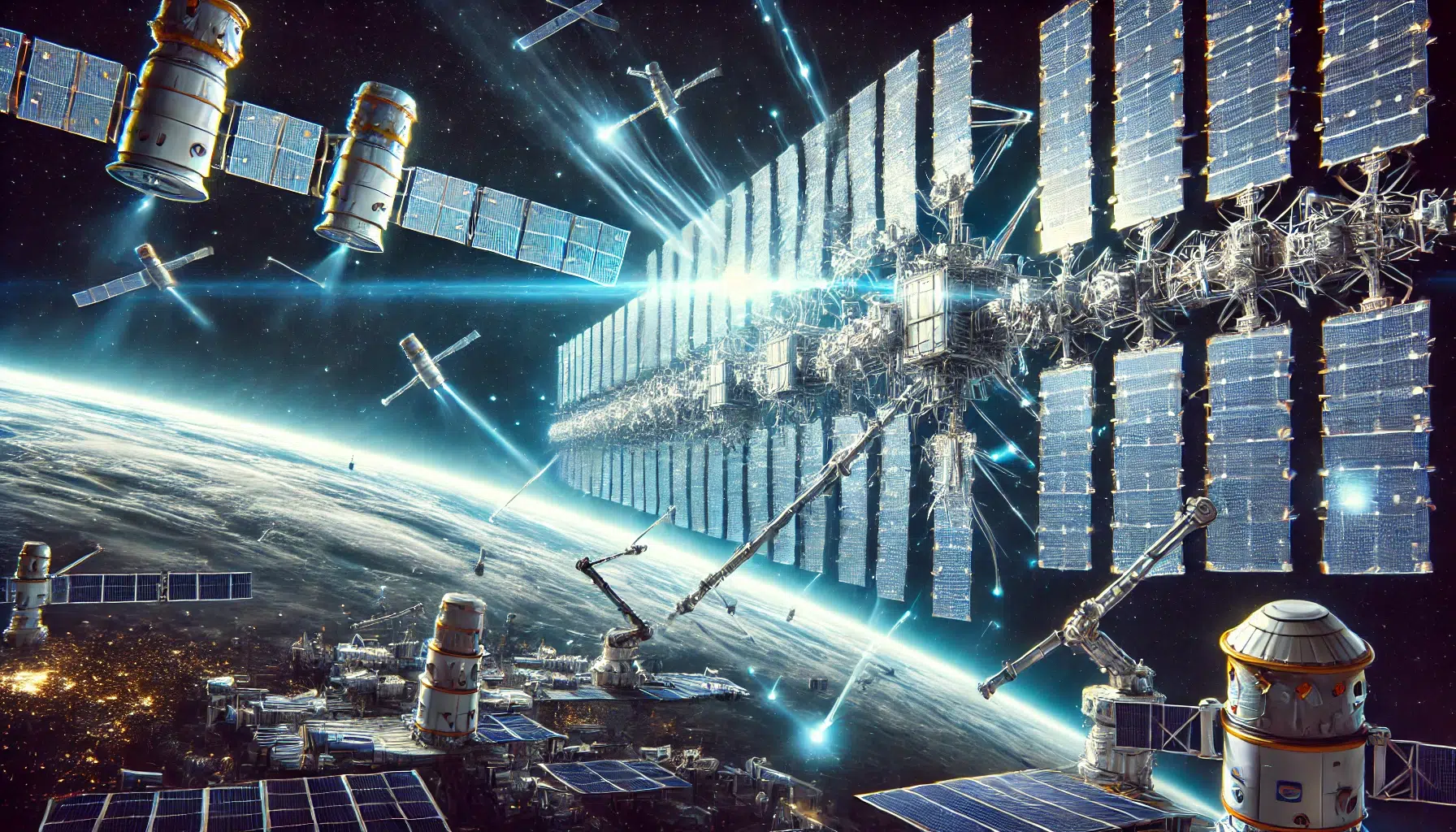
This continuous power generation capability addresses the intermittency issues faced by terrestrial solar and wind power, offering a reliable energy source that could significantly reduce reliance on fossil fuels. The project’s ability to harness solar energy unaffected by environmental or weather conditions positions it as a key player in achieving net-zero targets and supporting global sustainability goals.
Also Read: India’s Wind Power Capacity Set To Reach 63 GW By 2026-27
Comparative Analysis with Other Projects
To contextualize China’s effort, comparisons with other space solar power initiatives reveal its uniqueness. Caltech’s Space Solar Power Project, funded with over $100 million since 2013, successfully demonstrated wireless power transmission in 2023. However, this project is on a much smaller scale, focusing on lightweight, modular prototypes rather than a kilometer-wide structure. The International Space Station (ISS) also uses solar arrays, generating about 240 kW in direct sunlight, but these are for onboard power, not Earth transmission.
Other nations, such as the U.S. (Lockheed Martin, Northrop Grumman), the European Space Agency, and Japan’s JAXA, are investigating space-based solar power, but none have announced plans for a project of China’s magnitude. For instance, JAXA scheduled a small proof-of-concept satellite launch in 2025, but this is far from the scale of China’s kilometer-wide farm. Thus, China’s project stands out as the most ambitious, with no direct competitors in terms of size and energy output potential.
Table: Comparative Analysis of Space Solar Power Projects
Project |
Location |
Scale |
Status |
Key Features |
China’s Space Solar Farm |
Geostationary Orbit |
1 km wide |
Under construction, launch by 2033 |
Continuous power, microwave transmission |
Caltech SSPP |
Low Earth Orbit |
Small-scale prototype |
Demonstrated in 2023 |
Wireless power transmission, lightweight |
ISS Solar Arrays |
Low Earth Orbit |
240 kW in direct sunlight |
Operational |
Onboard power, not Earth transmission |
JAXA’s Proof-of-Concept |
Planned in 2025 |
Small satellite |
In development |
Feasibility testing |
This table highlights the scale and uniqueness of China’s project compared to others, emphasizing its leadership in space-based solar power.
Also Read: China Delivered World’s First Offshore FPSO With A Marine Carbon Capture System
Technical Challenges and Solutions
Building and maintaining a kilometer-wide solar farm in space presents significant technical challenges. The primary hurdles include launching and assembling such a large structure, efficiently transmitting power to Earth, ensuring structural stability in geostationary orbit, and managing costs. Launching requires heavy-lift capabilities, which China is addressing through the development of the Long March-9 rocket, a super-heavy carrier with a payload capacity of 150,000 kg to low Earth orbit and 54,000 kg to trans-lunar injection, with a first flight planned for 2033. This rocket, standing about 110 meters tall with a core stage diameter of 10 meters, is designed to transport the solar farm components, as detailed in Structural details of Long March 9.
Power transmission involves converting solar energy into electricity in space and beaming it back using microwaves, a technology being tested through phased experiments. The China Academy of Space Technology (CAST) plans to conduct a “Space high voltage transfer and wireless power transmission experiment” in low Earth orbit in 2028, generating 10 kW and testing transmission over 400 km, as reported in China aims for space-based solar power test in LEO in 2028, GEO in 2030 – SpaceNews. These tests aim to ensure efficiency and safety, addressing concerns about microwave beam impacts on living organisms, as explored in early testing facilities in Chongqing.
Structural stability is ensured by positioning the farm in a geostationary orbit, maintaining a fixed position relative to Earth. The project’s phased approach, starting with smaller tests, mitigates risks and accumulates data for scaling up, as seen in plans for a megawatt-level satellite by 2030 and a commercial-scale plant by 2050.
Also Read: China’s 2024 Coal Projects Threaten Climate Goals
Economic and Environmental Impacts
The economic impacts of the project are substantial, with the potential to generate significant growth through job creation in manufacturing, launch operations, and maintenance. The development of the Long March-9 and associated technologies could spur innovations in space and energy sectors, attracting investments and fostering international collaboration. According to Economic Impacts of Wind and Solar Photovoltaic Power Development in China – ScienceDirect, similar renewable energy projects have added value equivalent to 0.58% to 0.47% of GDP, suggesting a comparable economic boost for this space initiative.
Environmentally, the solar farm promises to reduce greenhouse gas emissions by providing a clean, continuous energy source, aligning with China’s targets of peak carbon emissions by 2030 and carbon neutrality by 2060. This could mitigate the environmental deterioration caused by fossil fuels, as noted in Economic and environmental impacts of photovoltaic power with the declining subsidy rate in China – ScienceDirect. However, there are potential concerns, such as the carbon footprint from multiple rocket launches, estimated to be lower than land-based solar in some analyses, but still requiring management to minimize environmental impact.
The project fits into China’s broader energy strategy, complementing terrestrial solar farms like the 3.5 GW installation in Urumqi, Xinjiang, activated in June 2024, and the “Solar Great Wall” in the Kubuqi Desert, expected to finish by 2030 with a 100 GW capacity. These efforts underscore China’s leadership in renewable energy, with the space solar farm adding a futuristic dimension to its portfolio.
Also Read: China Announces Reduction In Renewable Energy Subsidies Amid Solar And Wind Power Boom
Launch Vehicle Capabilities
The Long March-9 rocket is pivotal for the project’s success, designed as a super-heavy-lift vehicle with a liftoff weight of about 4,000 metric tons and thrust power of nearly 6,000 tons. Its specifications include a payload capacity of 150,000 kg to low Earth orbit and 54,000 kg to trans-lunar injection, making it capable of launching the solar farm’s components. The rocket’s development, including breakthroughs in propellant tank manufacturing using stir friction welding, demonstrates China’s progress toward meeting the project’s launch requirements.
This capability positions China to lead in space-based energy solutions, with the Long March-9 also supporting future lunar and deep-space missions, enhancing its strategic importance beyond the solar farm.
China’s giant space solar farm represents a pioneering effort in renewable energy, with significant potential to transform global energy supply through continuous, weather-independent power generation. Its unmatched scale, technical innovations, and strategic alignment with economic and environmental goals position it as a landmark project. While challenges remain, particularly in launch and transmission technologies, China’s phased approach and development of the Long March-9 rocket suggest a path toward realization, potentially setting a new standard for space-based energy solutions.
Also Read: Countries To Renew $200 Billion Nature Finance Deal At Rome Summit

0 Comments