
In the frozen silence of the Arctic, where sea ice once stretched endlessly across the horizon, polar bears face a growing habitat crisis that threatens their very survival. These massive arctic creatures, known as Ursus maritimus, use nearly all sea ice to hunt, procreate, and travel.
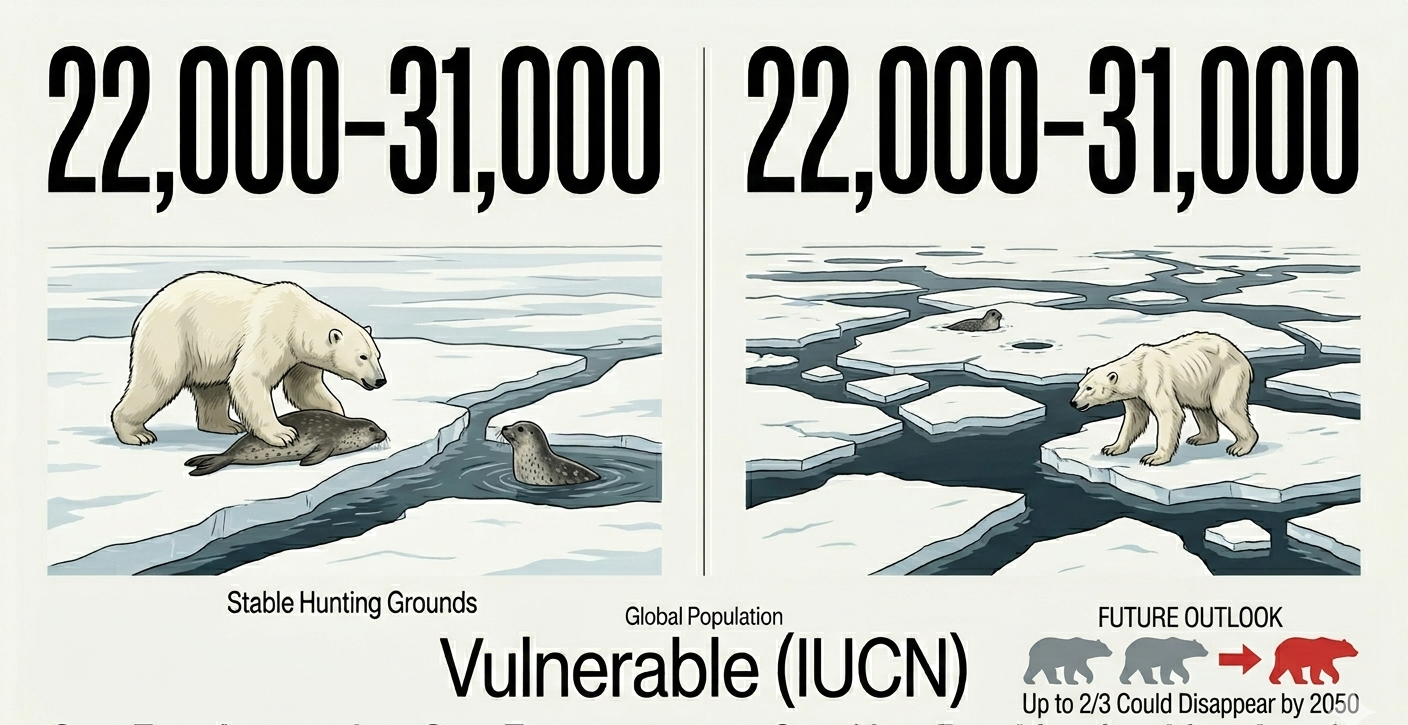
Today, with only an estimated 22,000 to 31,000 individuals remaining worldwide, polar bears face a growing habitat crisis as climate change rapidly transforms their icy home. Their story is no longer only about wilderness grandeur but about ecological urgency and global responsibility.
- The International Union for Conservation of Nature classifies polar bears as “Vulnerable” on its Red List.
- Scientists estimate the global population ranges between 22,000 and 31,000 individuals.
These figures confirm polar bears are facing a growing habitat crisis with limited room for demographic decline.
The Arctic’s Apex Predator
Polar bears are the biggest bears on Earth. Adult males are up to 1,500 pounds, with females being an average of 800 pounds. Their distinctive fur and thick fat also ensure that they remain warm even in conditions below -30 °C. They are dark in color, and under their white fur, they are warm because the sun is reflected on their skin as a way of warming themselves.
These changes had taken thousands of years to evolve in a location that had sea ice in abundance. But polar bears are in a growing habitat crisis because the ice they depend on is disappearing.
Also Read: New Study Outlines Best And Worst Outcomes Of Antarctic Warming
Sea Ice: The Foundation of Survival
Sea ice isn’t just frozen water; it is the main support for polar bear survival. Polar bears hunt seals by waiting near holes in the ice where seals breathe, using stealth and patience. If the ice is not stable, polar bears hunt less effectively. Since 1979, when satellites began monitoring, the reduction in sea ice in the Arctic has been approximately 13 percent in every decade.
The Arctic is warming nearly four times faster than the global average. The speeding warming means polar bears get a smaller hunting season every year.
Also Read: Rising Underwater Noise Pollution In The Arctic Threatens Marine Wildlife
Extended Ice-Free Periods and Body Mass Loss
Because ice melts earlier in spring and forms later in autumn, polar bears spend more time on land. There is not much high-calorie food on land, as there is on the sea with seals.
Eating berries and swimming long distances have not helped much. These findings show that polar bears face a growing habitat crisis and are losing their strength.
Also Read: World’s Largest Iceberg A23a Could Vanish Within Weeks
Subpopulations Under Stress
Polar bears live in 19 known groups across the Arctic. Some groups stay about the same size, while others are shrinking.
The U.S. Geological Survey says two‑thirds of polar bears may vanish by 2050 if greenhouse gases keep rising. This projection underscores how polar bears are facing a growing habitat crisis not just locally but across the circumpolar north.
Also Read: Arctic Wildfires Are Spreading Faster Than Ever, Causing Irreversible Climate Damage
Human-Bear Conflict on the Rise
As sea ice diminishes, polar bears increasingly venture into human settlements in search of food. Communities in Canada and Russia report rising incidents of bear encounters.
The World Wildlife Fund notes that human-polar bear conflicts are increasing in frequency due to habitat loss. Such interactions can result in lethal outcomes for bears and safety risks for residents.
The pattern reinforces that polar bears face a growing habitat crisis that pushes them closer to human infrastructure.
Also Read: Why Black Ice Is So Dangerous And How Climate Trends Could Affect Its Frequency
The Broader Climate Context
Climate change remains the primary driver behind sea ice loss. According to the IPCC, Arctic summer sea ice may decline significantly if emissions remain high.
Global temperatures are already about 1.1 °C higher than before the industrial era. These massive shifts lead to the collapse of local ecology. This means polar bears are in a growing habitat crisis linked directly to fossil‑fuel emissions.
Also Read: Penguins In Antarctica Adjust Breeding Cycles In Response To A Changing Climate
Conservation Efforts and International Agreements
The 1973 Agreement on the Conservation of Polar Bears was a historic joint effort by Arctic countries.
It controls hunting and encourages shared research. Today, conservation focuses on protecting habitat and reducing emissions. The IUCN says climate mitigation is the most important for polar bear survival.
Even with these efforts, polar bears need a big global change beyond wildlife management.
Also Read: Researchers Unveil Detailed Map Of Antarctica’s Landscape Hidden Beneath Ice Sheets
Data Snapshot: Polar Bear Status
| Indicator | Latest Data | Source |
|---|---|---|
| Global population estimate | 22,000–31,000 | https://www.iucnredlist.org |
| Conservation status | Vulnerable | https://www.iucnredlist.org |
| Arctic sea ice decline | 13% per decade | https://climate.nasa.gov |
| Projected decline by 2050 | Up to two-thirds loss | https://www.usgs.gov |
| Arctic warming rate | Four times the global average | https://www.nature.com |
These statistics illustrate why polar bears are facing a growing habitat crisis across multiple dimensions.
Also Read: Arctic Warming Is Out Of Control; But Can We Fix It?
Ecological Ripple Effects

Polar bears are top predators, controlling seal numbers and affecting marine life. In case they go down, Arctic food webs will be affected.
Arctic ecosystem sustains fishing and the Indigenous populations. According to the UN Environment Programme, the loss of biodiversity impairs the stability of the ecosystems at the global level.
When polar bears face a growing habitat crisis, the effects reach many other species.
Also Read: Antarctic Phytoplankton Shifts May Disrupt Carbon Storage And Marine Food Webs
Cultural and Symbolic Significance
For Indigenous Arctic peoples, polar bears have cultural, spiritual, and subsistence value. When polar bears are present, it shows ecological balance.
The drop in polar bear numbers shows bigger environmental instability. National Geographic calls polar bears “icons of climate change.” Their symbolic power makes people more aware that polar bears are in a growing habitat crisis that matches global warming.
Also Read: Study Warns Arctic Reindeer Could Nearly Vanish By 2100 — North Amеrica Hit Hardеst
What Must Change
Mitigating climate change is the best way to protect polar bears.
Key actions include:
- Rapid reduction of greenhouse gas emissions.
- Transition to renewable energy sources.
- Protection of Arctic marine habitats from industrial expansion.
- Strengthening community-based conflict mitigation programs.
- Continued scientific monitoring of subpopulations.
The IPCC stresses that limiting warming to 1.5 degrees Celsius significantly reduces Arctic ice loss. Only systemic transformation can reverse the trajectory that ensures polar bears face a growing habitat crisis.
Also Read: Arctic Birders Lead the Fight Against Climate Change and Avian Flu
A Future Hanging in Balance
Polar bears are remarkably resilient animals. They can swim long distances and travel hundreds of kilometers across shifting ice.
However, resilience has limits when environmental change accelerates beyond evolutionary adaptation. Scientists say the growing habitat crisis may soon exceed the polar bears’ ability to recover.
The window pertaining to the urgency of action each year is becoming smaller due to the warming of the Arctic.
Also Read: Populism And Climate Policy Backlash: Why Forcing People To Go Green Can Backfire
Conclusion
With only 22,000 to 31,000 polar bears left worldwide, they are at a risky point. The fact that sea ice is dying due to climate change disadvantages their hunting, making them lighter and increasing human conflicts.
Researchers foresee the occurrence of massive declines in population in case emissions remain elevated because the melting of the Arctic is four times more pronounced than the average temperature of the planet.
Polar bears face a growing habitat crisis that is linked to global climate trends. However, there is more than despair in their story. Possible solutions are agreements, science, and lower emissions.
Protecting polar bears means protecting the Arctic ecosystem and fighting climate change quickly and firmly. They must survive based on their power and the people who safeguard the weak ice.
Also Read: Why The World May Be Approaching Irreversible Climate Tipping Points
FAQs
1. How many polar bears exist globally?
Scientists say there are 22,000 to 31,000 polar bears globally.
2. Why are polar bears considered vulnerable?
They are classified as Vulnerable due to rapid sea ice loss caused by climate change.
3. How fast is Arctic sea ice disappearing?
Arctic sea ice has been declining at about 13 percent per decade since 1979.
4. What happens if sea ice continues to decline?
Researchers project that up to two-thirds of polar bears could disappear by 2050 under high-emission scenarios.
5. Can polar bears adapt to land-based diets?
Research shows bears lose significant body mass on land, indicating limited adaptation potential.
Also Read: Protecting Ocean Ecosystems Amid Pollution And Climate Change

0 Comments