
The Arctic is no longer the quiet refuge it once was. Underwater noise pollution in the Arctic has been rising steadily, carried in by ships, seismic surveys, military activity, and industrial expansion. What was once a vast acoustic sanctuary for whales, seals, and fish is becoming crowded with low-frequency hums and sharp mechanical pulses. For marine life that depends on sound to survive, this shift is deeply unsettling.
Noise, in the Arctic, travels far, and it lingers.
Why the Arctic Is Growing Louder
Melting Ice Opens the Door
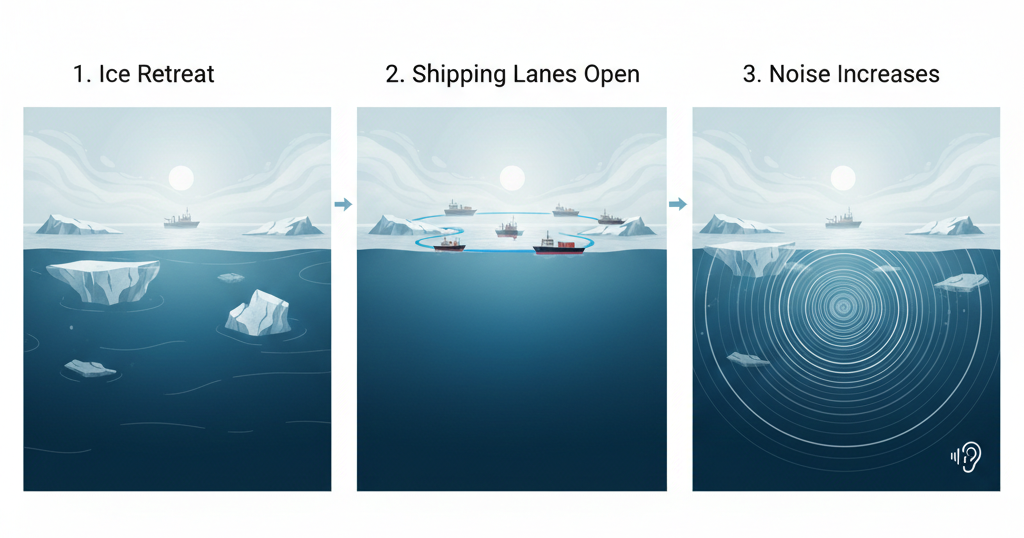
As sea ice retreats, human access to the Arctic expands. Shipping routes that were once frozen for most of the year are now navigable for longer periods.
Arctic sea ice extent has declined by about 13% per decade since satellite records began. This physical opening has directly increased underwater noise pollution in the Arctic.
More Ships, More Sound
Commercial shipping is one of the biggest contributors to underwater noise.
- Cargo ships
- Oil tankers
- Icebreakers
All generate continuous low-frequency noise that can travel hundreds of kilometres underwater.
As Arctic shipping traffic increases, silence becomes harder to find.
Also Read: Researchers Unveil Detailed Map Of Antarctica’s Landscape Hidden Beneath Ice Sheets
What Counts as Underwater Noise Pollution
Not All Noise Is the Same
Underwater noise pollution in the Arctic comes from multiple sources, each affecting wildlife differently.
- Commercial shipping engines
- Seismic airgun surveys for oil and gas
- Military sonar operations
- Offshore construction and drilling
Together, these sounds overlap and compound.
Why Sound Travels So Far in Cold Water
Cold Arctic waters transmit sound more efficiently than warmer seas. This means noise spreads farther, lasts longer, and overlaps more frequently.
In the Arctic, a single ship can alter the soundscape of an entire region.
Also Read: Doomsday Glacier Destabilisation Offers A Glimpse Into The Future Of Antarctic Ice Sheets
Marine Wildlife Depends on Sound to Live
Hearing Is Not Optional in the Ocean
Marine animals rely on sound for nearly everything.
- Communicate with one another
- Navigate long distances
- Locate food
- Avoid predators
When underwater noise pollution in the Arctic rises, these basic life functions are disrupted.
Species at Particular Risk
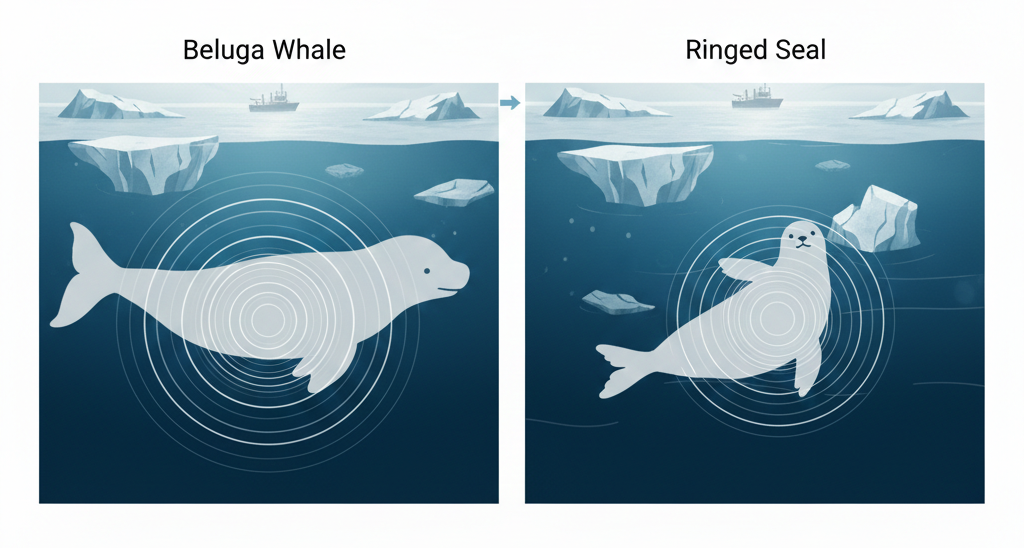
Arctic species are uniquely vulnerable because they evolved in a historically quiet environment.
Highly affected animals include:
- Bowhead whales
- Narwhals
- Beluga whales
- Ringed and bearded seals
These species depend heavily on acoustic cues in ice-covered waters.
Also Read: Marine Heatwaves Disrupt Ocean Life—From Kelp Forests To Giant Whales
How Noise Changes Animal Behavior
Communication Gets Masked
Low-frequency ship noise overlaps with the vocal range of many whales. This makes it harder for animals to hear each other, even at close distances.
As underwater noise pollution in the Arctic increases, communication spaces shrink.
Stress and Displacement
Noise doesn’t just confuse animals, it stresses them.
Studies show elevated stress hormones in marine mammals exposed to chronic noise. Some species abandon traditional feeding or breeding grounds altogether.
Also Read: World’s Oceans Turning Pale Green As Marine Life Declines
Seismic Surveys: Fast Flash, Long Lingering
What Seismic Airguns Do
Seismic surveys involve the use of powerful airguns in the creation of maps of the ocean bottom in order to locate oil and gas.
Each bang may be up to 230 decibels, which is one of the highest sounds that a human can produce in the ocean. In the Arctic, the distance between these sounds is much greater.
Effects on Fish and Invertebrates
The sound is not beneficial only to whales. It has been shown that seismic noise can:
This adds to the environmental effects of underwater noise pollution in the Arctic.
Also Read: 30% Ocean Protection Goal Moves Forward As UN Biodiversity Treaty Takes Effect
Military Activity Adds Another Layer
Sonar in Cold Waters
Naval sonar systems are designed for long-range detection. In Arctic conditions, sonar signals propagate efficiently, sometimes startling or disorienting marine mammals.
While military use is intermittent, its intensity can be severe.
Strategic Interest Is Growing
Due to the increasing intensity of Arctic politics, more military forces are coming in.
What the Data Shows
| Indicator | Finding | Source |
|---|---|---|
| Arctic sea ice decline | ~13% per decade | https://climate.nasa.gov |
| Increase in Arctic shipping | Rising annually | https://www.arctic.gov |
| Seismic airgun volume | Up to 230 dB | https://www.nature.com |
| Key species affected | Whales, seals, fish | https://www.amap.no |
| Sound travel distance in cold water | Hundreds of km | https://oceanservice.noaa.gov |
These numbers illustrate why underwater noise pollution in the Arctic is becoming a systemic threat.
Also Read: Arctic Wildfires Are Spreading Faster Than Ever, Causing Irreversible Climate Damage
Why Regulation Has Lagged Behind
Noise Is Invisible, So It’s Easier to Ignore
Unlike oil spills or plastic waste, noise leaves no visible trace. This makes it harder to regulate, monitor, and enforce. In the Arctic, vast distances further complicate oversight.
Fragmented Governance
The Arctic is governed by overlapping national and international frameworks.
Noise regulation varies widely between countries and activities. As a result, underwater noise pollution in the Arctic often slips through regulatory gaps.
Also Read: Penguins In Antarctica Adjust Breeding Cycles In Response To A Changing Climate
Can the Arctic Be Quieted Again?
Practical Mitigation Measures Exist
Solutions are available, though not yet widely adopted.
These changes reduce noise without halting activity.
The Cost of Delay
As industrial activity increases, restoring quiet becomes harder. Prevention is significantly cheaper than remediation. Acting early could prevent permanent changes to Arctic soundscapes.
Also Read: Greenland’s Polar Bears Are Showing Genetic Shifts As Arctic Temperatures Rise
Conclusion
In the Arctic, underwater noise pollution is not visible as a threat, such as smoke or oil. It propagates silently and transforms life in the ocean in a manner that is difficult to remedy. To animals that have been dependent on sound, this loud sound is not only an inconvenience but a big issue.
The Arctic might appear barren when viewed with the naked eye, but in its depths, it is listening. It is the sound of what we shall hear hereafter.
FAQs
1. What is underwater noise pollution in the Arctic?
Disturbance of ocean life in Arctic waters caused by the sounds made by people.
2. Why does the Arctic have a higher sensitivity to noise?
Cold water allows sound to go longer and farther.
3. Which are the most affected animals?
Whales, seals, and fish, which depend on sound to a great extent.
4. Is the principal cause of noise shipping?
Shipping is a large contributor to noise, along with seismic surveys and sonar.
5. Can underwater noise be reduced?
Yes, through quieter technologies and better management practices.
Also Read: Arctic Ice Loss Triggers Global Sea Level Emergency

0 Comments