
On July 15, 2025, Tesla officially launched the Model Y in Mumbai. Tesla’s launch in India was a critical catalyzing event for India’s electric mobility ecosystem. The Model Y competes against BMW, Mercedes-Benz, Volvo, and Kia, priced at ₹60 lakh (for the RWD version) and ₹69 lakh (for the Long Range variant).

What Makes Tesla’s Launch in India Significant?
As the world’s third-largest automobile market, India now has a global EV leader negotiating its territory. Tesla offers a range of high-performance electric vehicles and advanced features such as Autopilot. Not only could this move set new quality standards for competitors, but it may also push competitors to upgrade their products.
Despite the fact that EVs only made up about 6% of passenger vehicle production in 2025, there is an opportunity for increased consumer interest and accelerated adoption of EVs, given Tesla’s brand awareness and reputation. Additionally, it could open the door for more customer investment and confirm India’s increasing importance in the global EV market. However, very high import fees may affect Tesla’s pricing and market access.
Also Read: Soaring Electric Truck Sales In China Deliver A Major Blow To Diesel Dominance
How Does Tesla’s Model Y Stack Up Against Other Luxury EVs in India?
To evaluate Tesla’s positioning, the table compares the Model Y with other premium EVs based on pricing, range, and battery specs:
| Model | Price (starting, ex-showroom) | Range (WLTP) | Battery Capacity |
|---|---|---|---|
| Tesla Model Y RWD | ₹59.89 lakh | 500 km | ~60 kWh |
| BMW iX1 xDrive30 | ₹66.90 lakh | 440 km | 66.4 kWh |
| Mercedes-Benz EQB 300 4Matic | ₹74.50 lakh | 423 km | 66.5 kWh |
| Volvo EX40 Single | ₹50.10 lakh | 475 km | 69 kWh |
| Kia EV6 GT-Line AWD | ₹65.97 lakh | 506 km | 77.4 kWh |
The Tesla Model Y RWD, priced at ₹59.89 lakh, offers a 500 km range—more than the EQB and iX1, while undercutting them on price. Although slightly costlier than the Volvo EX40, it outpaces it in range. The Kia EV6 has a greater range than the Model Y, but it does cost more and has all-wheel drive. While there is a good value proposition regarding a Tesla, it may expose limited desirability due to high import costs.
Also Read: Commercial Electric Vehicles As A Strategic Lever For ESG And Operational Excellence
What is the Present Outlook for India’s Electric Vehicle Market?
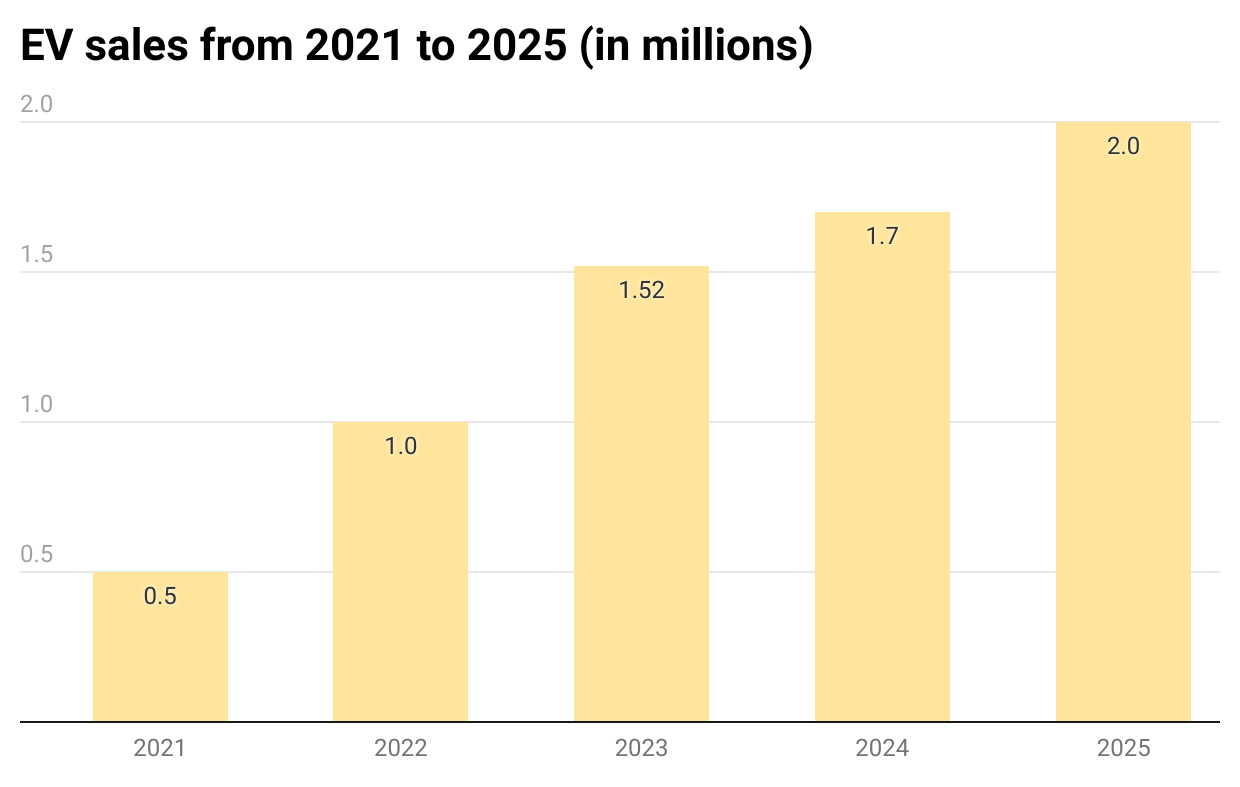
India’s electric vehicle market is currently an exciting space, evolving quickly due to government incentives, developments in infrastructure, and an increase in awareness of the environment. According to JMK Research & Analytics, EV sales increased from 0.5 million units in 2021 to more than 2 million units in FY2025 (April 2024–March 2025). EVs are dominated by electric two-wheelers with north of 50% market share, electric passenger three-wheelers have a 36% EV market share, and electric cars had a 20% increase in sales to 99,165 in 2024, led by Tata Motors’ sales with 62% of the market share.
The FAME India Scheme, reduced battery import duties, and rising consumer demand drive this growth. Nevertheless, Tesla’s launch in India will face a challenge from successful local brands, along with inconsistent charging infrastructure.
Also Read: Surge In Electric Cars And Heat Pumps Purchases Not Enough, Warns Government Climate Panel
What Effect Might Tesla Have on India’s EV Ecosystem?
- More Competition: Existing brands like Tata, MG, and premium brands will be pushed to upgrade faster to keep up.
- Charging Growth: Tesla stated they will build four stations in Mumbai and more in Delhi. If these Superchargers are made open access to other EVs, the present ratio of 135 EVs to every charger in 2024 could be lowered.
- Policy Influence: Tesla’s introduction in India could inspire the Indian government to lower import tariffs or expand subsidies for EVs.
- Future Manufacturing: Tesla will begin by importing cars, but if manufacturing were to happen in India, it could bring jobs and strengthen domestic supply chains.
- Technology Influence: Tesla could influence India’s domestic R&D for EVs, at least in autonomy and battery systems, and perhaps lead to more startups.
Even if there are still questions about Tesla’s affordability in a lower-price market, the company’s introduction could hasten India’s move towards its goal of 30% EV market share by 2030.
Also Read: One In Four Cars Sold Globally In 2025 Will Be Electric, Breaking Records: IEA Report
What Issues May Tesla Encounter?
- Import Duties: Tesla cannot offer assembly in India and must incur up to 100% on imports, limiting price competitiveness with locally made EVs.
- Brand Loyalty Amongst Competitors: BMW, Mercedes, and Tata Motors have a very loyal customer base. Tata has 53% of the EV market; MG has 28%.
- Sparse Charging Network: Although public charging has increased from 1,800 in 2022 to 16,347 by March 2024, parts of the country still have barriers due to sparse charging stations.
- After-Sales Support: It will take capital investments to build a trusted service network, making it difficult to gain consumer loyalty in a market that values price.
Each of these barriers also adds additional operational complexity for Tesla’s launch in India while balancing a premium approach in a country with so much need.
Also Read: Electric City Bikes For Women: What To Consider + 4 Must-Have Fiido Models
Frequently Asked Questions
1. Will Tesla manufacture in India?
Currently, as of July 2025, there is no known manufacturing plan. However, some reports mention that Tesla may consider investing $3-5 billion in locations like Gujarat or Maharashtra. For the time being, Tesla will be continuing to import the vehicles while paying substantial duties.
2. What government policies would help the adoption of EVs?
One of the major incentives is the 2024 EV Policy, which cuts down duties to 15% on EVs priced over $35,000 that show proof of local manufacturing. The other major incentive is the FAME-II Scheme, which provided funding for 2,636 EV charging stations across 62 cities.
3. What is Tesla’s plan for Superchargers?
Tesla plans to roll out eight Supercharger stations (4 in Delhi-NCR and 4 in Mumbai), and other locations will follow after Tesla’s launch in India.
Also Read: More Than A Fifth Of Zomato’s Delhi Deliveries Now Electric, Says CSO Anjalli Ravi Kumar

0 Comments