
Every February, Yosemite National Park becomes the stage for one of the most mesmerizing natural spectacles in North America. For a brief window of time, sunset transforms a small seasonal waterfall into a glowing stream of molten gold. This breathtaking event, called the firefall at Yosemite’s Horsetail Fall, draws thousands of visitors, photographers, and nature lovers who want to see a waterfall made of fire. The firefall happens only when the weather is just right, so it is one of the rarest natural optical tricks.
The firefall usually shows up during a short two‑week period in mid‑to‑late February. During this narrow timeframe, the firefall at Yosemite’s Horsetail Fall transforms the granite face of El Capitan into a luminous cascade that lasts only a few minutes each evening.
What Is the Firefall Phenomenon?
The firefall at Yosemite’s Horsetail Fall is not actual fire but an optical illusion created by sunlight interacting with water and granite cliffs. Horsetail Fall is an ephemeral waterfall, meaning it only flows seasonally when snow begins melting on Yosemite’s high peaks. When the flow aligns perfectly with the angle of the setting sun, the falling water glows orange and red.
The effect happens because the sunlight strikes El Capitan at a very specific angle during sunset. For about ten minutes each evening, the firefall at Yosemite’s Horsetail Fall appears as a fiery ribbon descending the cliff face. Once the sun dips below the horizon, the glowing effect disappears instantly.
Also Read: State Of India Environment Report 2026 Raises Alarm Over Climate Risks And Environmental Gaps
The Science Behind the Illusion

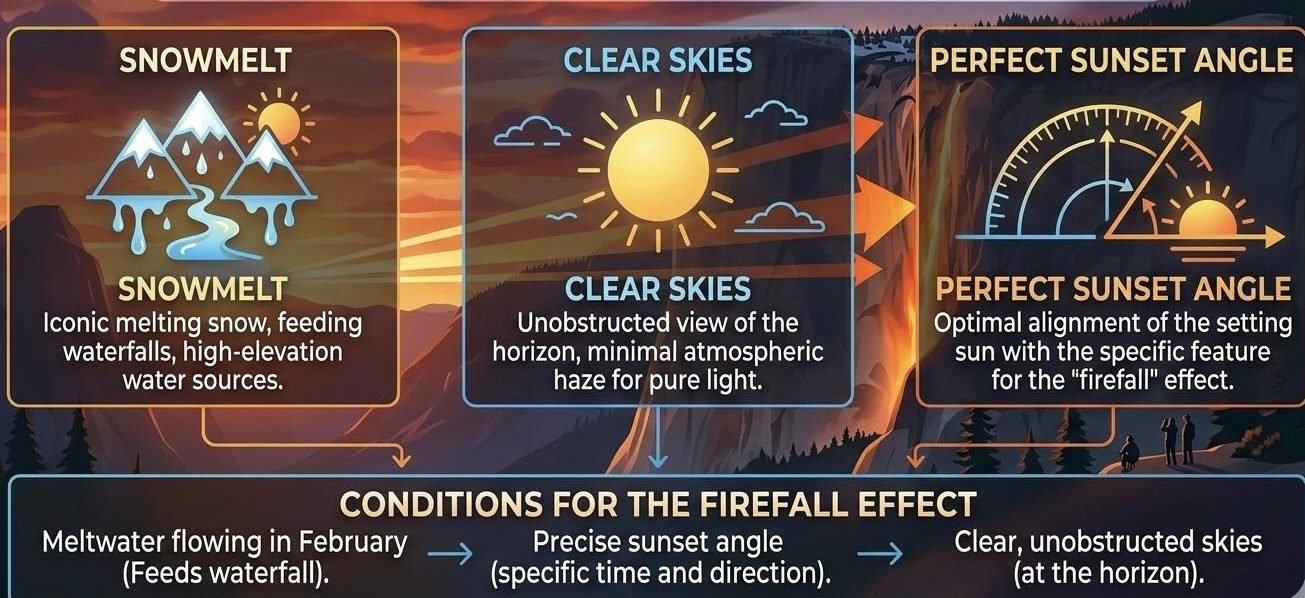
Several natural factors must align perfectly for the firefall at Yosemite’s Horsetail Fall to occur.
First, snow must melt enough to produce a steady stream of water. Without sufficient runoff, the waterfall simply does not appear. Second, skies must remain clear so the sunlight can reach the waterfall unobstructed. Finally, the sunset angle must strike the falling water directly.
These conditions typically occur only during a two-week period in February. The combination of these elements creates the brilliant glow that defines the firefall at Yosemite’s Horsetail Fall.
Also Read: India Tightens Tiger Tourism Rules To Strengthen Conservation And Sustainability
A Natural Event That Captivates Photographers

Photographers travel from across the world to capture the fiery waterfall effect. The glowing cascade against the massive granite wall of El Capitan creates an image unlike anything else in nature. The firefall got national fame when wildlife photographer Galen Rowell took a striking picture of it in 1973.
The photo went viral and popularized the incident globally. Today, social media and digital cameras have made the firefall even more popular. Each winter, hundreds of photographers gather with tripods along Yosemite Valley, hoping to capture the perfect image.
Also Read: New Environmental Regulations Set To Reshape Saudi Arabia’s Coastal Tourism
The History of Yosemite’s Man-Made Firefall
Interestingly, the name “firefall” actually originated from a human-made spectacle rather than the natural phenomenon.
In 1872, an early Yosemite tourism promoter named James MacCaulay began a nightly show for visitors. Workers would push burning embers from a bonfire atop Glacier Point so they cascaded down the cliff like a glowing waterfall. Tourists gathered in Yosemite Valley below to watch the fiery display.
For nearly a century, this artificial firefall entertained visitors. Eventually, however, environmental concerns led the National Park Service to discontinue the practice in 1968.
After photographers later documented the natural glow of Horsetail Fall, the name “firefall” naturally transferred to the real phenomenon.
Also Read: Tourists To Pay Hawaii’s New Green Tax — Here’s What It Means
How Climate and Weather Influence the Event
While the firefall at Yosemite’s Horsetail Fall appears annually, its intensity varies greatly from year to year. Weather patterns play a crucial role in determining whether the event occurs.
Heavy snowfall during winter provides the necessary meltwater. Warm but sunny conditions during February help trigger the flow of seasonal waterfalls. Climate change may also influence snowpack levels in the Sierra Nevada mountains. The Sierra Nevada snowpack provides about 30% of California’s freshwater supply.
Changes in snow accumulation could therefore affect how frequently the firefall at Yosemite’s Horsetail Fall occurs in the future.
Also Read: China’s Green Tourism Boom Sets A Global Standard For Sustainable Travel And Economic Growth
Viewing the Firefall in Yosemite Valley
Visitors hoping to witness the firefall at Yosemite’s Horsetail Fall must travel to Yosemite Valley during the late afternoon hours. The most popular viewing location is near the El Capitan Picnic Area.
From this vantage point, spectators can watch the waterfall glowing on the granite wall above. The viewing area requires about a three-mile walk from the Yosemite Valley Lodge.
Visitors typically begin gathering hours before sunset to secure a good viewing position. Once the sun aligns with the waterfall, the glowing spectacle begins and lasts roughly ten minutes.
Also Read: Climate Change Fuels Increase In Fire-Prone Weather Days Worldwide: Study
Data Snapshot: Yosemite Firefall and Visitor Trends
| Indicator | Latest Data | Source |
|---|---|---|
| Annual Yosemite visitors | 3.6 million | https://www.nps.gov |
| Firefall viewing period | Mid-late February | https://www.nps.gov |
| Duration of glowing effect | ~10 minutes daily | https://www.nationalgeographic.com |
| El Capitan height | 3,000 feet | https://www.nps.gov |
| Sierra Nevada snowpack contribution to water supply | ~30% | https://www.nature.com |
These figures highlight the scale of interest surrounding the firefall at Yosemite’s Horsetail Fall.
Also Read: Experts Call AI Climate Solutions Greenwashing Amid Rising Skepticism
A Delicate Balance Between Tourism and Conservation
The popularity of the firefall at Yosemite’s Horsetail Fall presents challenges for park managers. Large crowds gathering in sensitive natural areas can damage vegetation and disturb wildlife.
In past years, the National Park Service required reservations to manage the surge of visitors during the firefall season. However, in 2026, reservations were not required for viewing areas.
Park officials continue to encourage responsible tourism practices. Protecting the fragile Yosemite Valley ecosystem ensures future generations can experience the firefall at Yosemite’s Horsetail Fall.
Also Read: $2.3 Trillion Global Sports Economy At Risk From Climate Shocks, New Research Says
Why the Firefall Feels Magical
Part of the magic of the firefall at Yosemite’s Horsetail Fall lies in its fleeting nature. Unlike permanent landmarks, this glowing waterfall exists only briefly each year and only for minutes each day.
The experience also depends on patience and luck. Visitors must endure cold February temperatures and uncertain weather conditions.
The moment is nearly surreal when at last the setting sun illuminates the water. The firefall turns a simple waterfall into something that looks almost supernatural.
Also Read: Populism And Climate Policy Backlash: Why Forcing People To Go Green Can Backfire
Tips for Seeing the Firefall
There are a few useful points that visitors who desire to see it must remember:
- Get there some hours before sunset to get a good place.
- Wear warm clothes, as the nights in February in Yosemite are very cold.
- If you would like to take pictures in low light, bring a tripod and a camera.
- View the weather forecast and park updates in advance.
- Do not stay in the specific viewing places to conserve the plants of the park.
These steps help you have a better chance of seeing the firefall under the best conditions.
Also Read: Why The World May Be Approaching Irreversible Climate Tipping Points
The Broader Appeal of Yosemite’s Natural Wonders
The firefall at Yosemite’s Horsetail Fall represents only one of the many natural wonders found within Yosemite National Park. The park is famous for its towering granite cliffs, giant sequoia trees, and spectacular waterfalls.
El Capitan alone rises approximately 3,000 feet above Yosemite Valley.
The combination of geological grandeur and seasonal phenomena makes Yosemite one of the most visited national parks in the United States.
Each winter, the glowing waterfall reminds visitors that even familiar landscapes can reveal new beauty under the right conditions.
Also Read: Mountain Ecosystems Under Pressure From Climate Change And Rising Temperatures
Conclusion
The firefall at Yosemite’s Horsetail Fall is one of nature’s most stunning tricks, using sunlight, melting snow, and towering granite cliffs.
For a short time in February every year, the sky near El Capitan lights up with a glowing waterfall that looks like it’s burning with gold. Thousands of visitors and photographers come to see this short show and travel far to see it.
The firefall is more than a pretty sight. It displays the monolithic equilibrium of the climate, snow, and mountain life.
When others are united under El Capitan to see it, they get the feeling of a science and wonder meeting. The firefall reminds us that amazing natural events are also fragile and need careful care.
Also Read: Protecting Ocean Ecosystems Amid Pollution And Climate Change
FAQs
1. What causes the firefall at Yosemite’s Horsetail Fall?
Water becomes glowing when the setting sun strikes it at the right angle during the month of February.
2. How long does the firefall last each day?
The glowing waterfall usually lasts about ten minutes at sunset.
3. When is the best time to see the firefall?
It normally takes place in mid-February to late-February.
4. Where can visitors watch the firefall?
It is located in the best location, close to the El Capitan Picnic Area in Yosemite Valley.
5. What is the number of visitors to Yosemite?
The average visitor count to Yosemite National Park is 3.6 million per year.
Also Read: Rising Underwater Noise Pollution In The Arctic Threatens Marine Wildlife

0 Comments