
France’s Floating Igloo has officially begun one of the world’s most ambitious Arctic research missions, marking a significant milestone in international climate science. The Tara Polar Station, a floating laboratory designed to resemble a giant aluminum igloo, departed from the French port of Lorient to begin a nearly two-year drift across the Arctic Ocean. Built to survive temperatures as low as -52°C (-62°F) and withstand immense sea-ice pressure, the station will drift naturally with Arctic pack ice from September 2026 until the end of 2027, eventually reaching the Fram Strait between Greenland and Svalbard. More than 30 research centers from 12 countries, including Germany, Canada, Spain, the United States, Switzerland, and Japan, are participating in the mission.
Scientists aboard will collect over 10,000 environmental samples to better understand biodiversity, climate change, sea ice, ocean chemistry, and atmospheric conditions in one of Earth’s least explored regions. With the Arctic warming nearly four times faster than the global average, according to recent scientific assessments, the expedition comes at a critical moment for climate research.
A floating research station resembling a giant aluminium igloo has set out from France to begin a long-term mission in the Arctic that will see it drift with the polar ice in the most hostile of environments.
The Tara Polar Station’s shape enables it to withstand ice pressure… pic.twitter.com/nHuiPJk8t3
— AFP News Agency (@AFP) July 20, 2026
A Floating Laboratory Designed for the Arctic
Unlike conventional research ships, the Tara Polar Station has been engineered specifically to become part of the Arctic ice.
Its rounded aluminum hull allows the station to rise safely when compressed by thick sea ice rather than being crushed. Beginning in mid-August, an icebreaker will escort the vessel along Russia’s northern coastline before it becomes intentionally trapped in pack ice by early September.
Once frozen into the ice, the station will drift approximately 10 kilometers (6 miles) per day, following natural ocean currents across the Arctic until it reaches the Fram Strait by late 2027.
This passive drifting strategy enables researchers to observe seasonal changes continuously instead of relying on short research cruises.
Also Read: First Detection Of Nanoplastics In Antarctic Soils Raises Global Pollution Concerns
International Collaboration on an Unusual Scale
The expedition represents one of the largest collaborative Arctic science missions ever undertaken.
- Although built in France, France’s Floating Igloo brings together experts from 30 research institutions across 12 countries, highlighting the growing importance of global cooperation in addressing climate change.
- French Minister for the Sea Catherine Chabaud attended the departure ceremony in Lorient alongside hundreds of supporters.
According to Romain Trouble, Executive Director of the Tara Ocean Foundation: “The Arctic is an ocean that has been little studied and is already changing significantly.”
He emphasized that spending only a few weeks in the Arctic each year is no longer enough to understand the region’s rapid transformation.
Also Read: Scientists Decode Antarctica’s 30 To 50 Year Warning For Rising Seas
Living in One of the World’s Harshest Environments
Life aboard the floating station will be physically and mentally demanding.
The station will host:
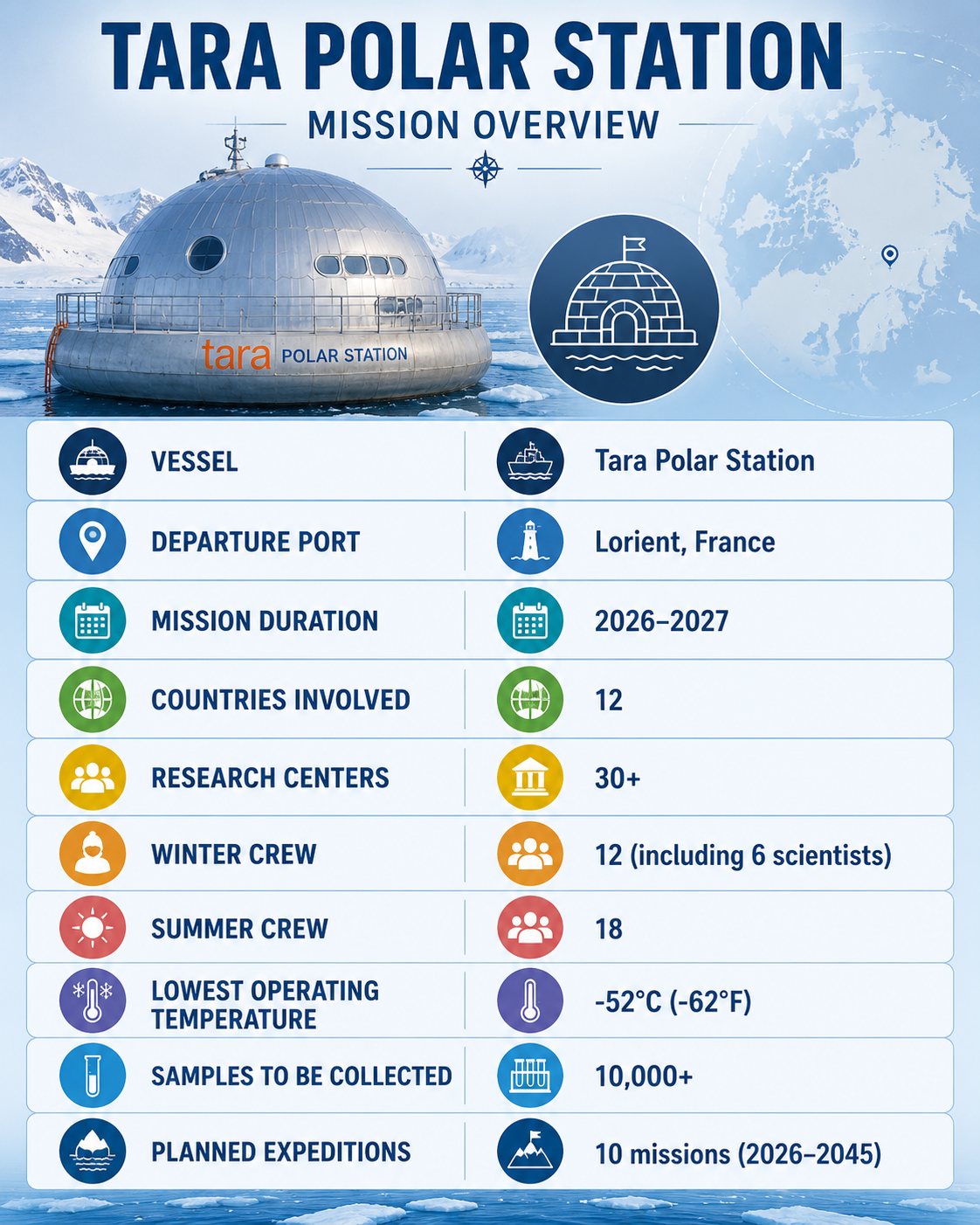
Mission Overview |
Details |
|---|---|
Vessel |
Tara Polar Station |
Departure Port |
Lorient, France |
Mission Duration |
2026-2027 |
Countries Involved |
12 |
Research Centers |
30+ |
Winter Crew |
12 (including 6 scientists) |
Summer Crew |
18 |
Lowest Operating Temperature |
-52°C (-62°F) |
Samples to be Collected |
10,000+ |
Planned Expeditions |
10 missions (2026-2045) |
Crew members were selected after rigorous medical examinations, psychological evaluations, and team-building exercises.
Expedition Director Clementine Moulin explained that the team prioritized compatibility over adventure experience.
“We weren’t looking for adventurers who want to head to the North Pole alone. The idea is rather to have people who get along well to experience this confined human environment together.”
Winter crews will spend five months in complete darkness, enduring isolation, freezing temperatures, and limited communication with the outside world.
Also Read: Antarctic Megaberg’s 40-Year Ocean Voyage Finally Ends
Polar Bears and Extreme Conditions Pose Real Risks
Scientific research in the Arctic comes with significant safety challenges.
Polar bears remain one of the expedition’s greatest concerns.
- Crew member Eric Pelletier, a genomics researcher, noted that encounters with polar bears require constant vigilance because the animals naturally hunt across sea ice.
- Every expedition member has received firearms training to respond to emergencies, while a specially trained polar bear detection dog will accompany the mission to identify approaching animals before they become dangerous.
These safety measures are essential because researchers will frequently leave the station to collect ice and snow samples.
Also Read: Swiss Glaciers Exhaust Snow Reserves Amid European Heatwave, Triggering Rapid Ice Melt
France’s Floating Igloo Will Unlock Arctic Climate Secrets
The primary objective of France’s Floating Igloo is long-term scientific observation.
Using specialized openings beneath the station and advanced monitoring instruments, scientists will continuously measure ocean temperature and salinity, sea ice thickness, atmospheric composition, marine biodiversity, carbon cycling, microbial ecosystems, air pollution, and aerosols.
Researchers will collect more than 10,000 samples from seawater, sea ice, snow, and the atmosphere.
Unlike previous Arctic expeditions that lasted only weeks or months, this mission will capture an entire annual cycle, allowing scientists to observe seasonal changes that are otherwise impossible to monitor.
Also Read: How Rapid Glacier Melt Is Revealing Long-Lost Objects And Ecosystems
Why Arctic Biodiversity Matters
The Arctic hosts thousands of organisms specially adapted to extreme cold.
Many microorganisms, algae, plankton, fish, and marine mammals depend on stable sea ice ecosystems for survival.
Romain Trouble warned that climate change threatens this unique biodiversity. He explained that if Arctic conditions continue changing rapidly, scientists could lose entire ecosystems before they are fully understood.
“We could potentially lose an entire chapter of the evolution of life on this planet without even having had time to document it.”
According to the World Meteorological Organization (WMO) and the Intergovernmental Panel on Climate Change (IPCC):
- The Arctic is warming around four times faster than the global average.
- Arctic summer sea ice has declined by roughly 13% per decade since satellite observations began in 1979.
- Rising Arctic temperatures influence weather patterns, sea-level rise, and global ocean circulation.
These changes make continuous scientific monitoring increasingly important.
Also Read: Glacier Grafting: The Ancient Art Of Growing Water From Stone
A Long-Term Vision for Polar Science
The current expedition is only the beginning.
The Tara Ocean Foundation plans 10 drifting missions between 2026 and 2045, launching a new expedition every two years.
By creating long-term datasets spanning decades, scientists hope to better understand how climate change affects Arctic ecosystems and improve global climate models used by researchers and policymakers.
As France’s Floating Igloo drifts across one of Earth’s most remote oceans, it represents more than an engineering achievement; it serves as a floating observatory that could reshape our understanding of the rapidly changing Arctic and help guide future climate action.
Also Read: Glaciers In The Alps Expected To Hit Peak Extinction Rate In Eight Years
Frequently Asked Questions
1. What is France’s Floating Igloo?
France’s Floating Igloo refers to the Tara Polar Station, a specially designed floating Arctic research station built to drift with sea ice while conducting long-term climate and biodiversity research.
2. Why is the Tara Polar Station important?
It enables scientists to study the Arctic continuously for nearly two years, collecting valuable data on climate change, sea ice, ocean chemistry, and Arctic ecosystems.
3. How many countries are participating in the mission?
The expedition involves over 30 research centers from 12 countries, including France, Germany, Canada, Spain, the United States, Switzerland, and Japan.
Also Read: Glaciers Are Reshaping Earth Faster Than Ever, Scientists Warn

0 Comments