
Updated 13 November 2026
The environment is everything that surrounds a living thing and affects its life: the air it breathes, the water and soil it depends on, the other organisms around it and, for people, the buildings and societies they live in. Its parts are either biotic (living: plants, animals, fungi and microorganisms) or abiotic (non-living: air, water, soil, sunlight and temperature).
The Two Main Types of Environment
Type | What it includes | Examples |
|---|---|---|
Natural (geographical) | The atmosphere, hydrosphere, lithosphere and biosphere, shaped by natural processes | Forests, rivers, oceans, mountains, deserts, wildlife |
Man-made (human-made) | Structures and systems that people create or modify to meet their needs | Houses, roads, bridges, dams, farms, factories, parks, cities |
Human (social), listed separately in some textbooks | The people and institutions that shape how we live | Family, community, schools, religion, the economy |
1. Natural (Geographical) Environment
The natural environment is everything that formed without human help. Geographers describe it as four interacting “spheres”:
- Lithosphere: the solid outer layer of the Earth, with its rocks, soil and landforms such as mountains, plains and plateaus.
- Hydrosphere: all of Earth’s water, including oceans, rivers, lakes, groundwater and ice.
- Atmosphere: the blanket of gases around the planet, mostly nitrogen (about 78%) and oxygen (about 21%).
- Biosphere: the narrow zone where land, water and air meet and life exists, from plants and animals to microorganisms.
2. Man-Made (Human-Made) Environment
The man-made environment is what people have added to or changed in the natural one to meet their needs for shelter, food, transport and work. It includes buildings, roads, bridges, dams, railways, industries, monuments and parks, and also the managed landscapes of farms and plantations. Many syllabuses group the social environment, meaning families, communities, schools and governments, with the man-made environment because it too is created by people.
A park is a useful test case: it is full of grass and trees, but it is a man-made environment, because people designed it and maintain it.
Natural vs Man-Made Environment: Key Differences
Basis | Natural environment | Man-made environment |
|---|---|---|
Origin | Formed by natural processes | Created or modified by people |
Pace of change | Usually slow, over thousands of years | Fast, can change within years |
Upkeep | Self-sustaining and self-renewing | Needs constant maintenance and energy |
Examples | Forest, river, mountain, ocean | City, dam, farm, park |
Eight Kinds of Environment, in More Detail
Geographers and ecologists often go further than the two-way split. The sections below look at eight kinds of environment: natural, built, aquatic, terrestrial, social, atmospheric, underground and space. Each one belongs to either the natural or the man-made type above.
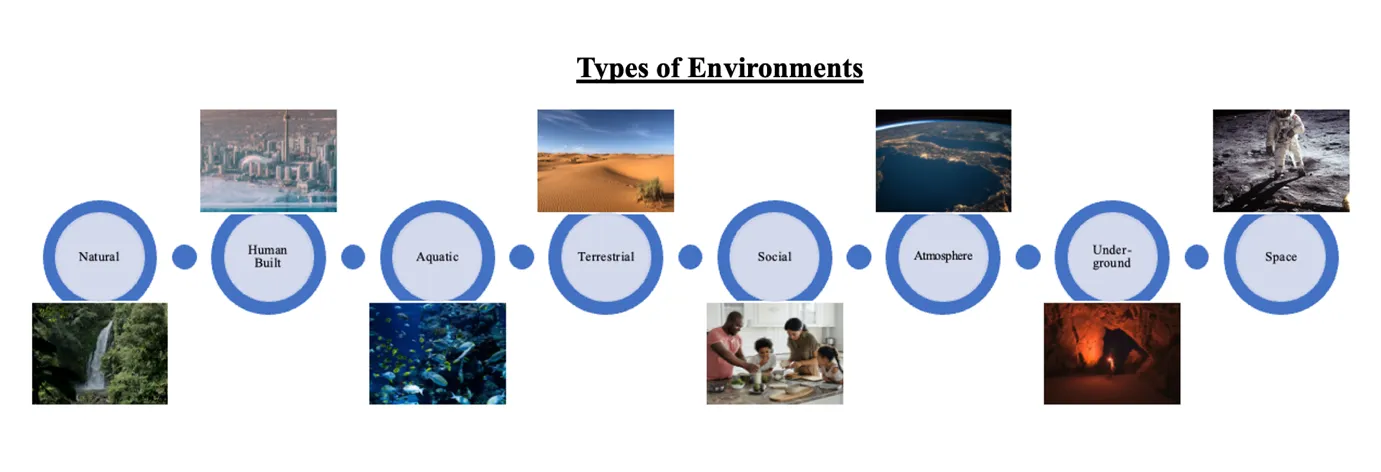
Natural Environments
Natural environments refer to ecological systems that exist without significant human influence. Over thousands of years, natural processes like climate, geological forces, and biological interactions have shaped natural environments. These types of environments support a staggering diversity of flora, fauna, and microorganisms, forming complex food webs and intricate ecological relationships.
1. Forests
Forests are vast natural environments characterized by dense vegetation consisting primarily of trees. They are essential for maintaining global biodiversity, providing habitat for countless species, and serving as carbon sinks. Different types of forests exist, including mangrove forests, boreal forests, temperate forests, and tropical rainforests.
2. Deserts
Low precipitation levels, high temperatures, and sparse vegetation cover are characteristics of deserts, which are arid regions. These harsh environments are home to specialized plant and animal species adapted to survive in extreme conditions. Deserts play a vital role in global ecosystems, influencing weather patterns and serving as reservoirs of unique biodiversity.
3. Grasslands
Grasslands are vast areas where grasses predominate, with few trees or shrubs. They contribute to soil fertility, carbon sequestration, and the maintenance of water cycles. They are also essential for agricultural production.
4. Wetlands
Wetlands are transitional environments that exist between terrestrial and aquatic ecosystems. Wetlands provide numerous ecosystem services, such as water filtration, flood control, and habitat for diverse plant and animal species.
5. Mountainous Environments
Rugged landscapes, steep slopes, and high elevations are characteristics of mountainous environments. They provide essential ecosystem services such as freshwater supply, habitat for specialized species, and recreational opportunities. They are often rich in biodiversity, harbouring endemic plants and animals.
Also Read: Impacts of Humans on Ecosystems
Built Environments
Built environments are habitations, workplaces, and recreational areas created or modified by humans. Architectural layouts, land use patterns, and technological developments all play a part in defining these environments.
- Urban environments represent highly populated areas characterized by extensive development, high-rise buildings, transportation systems, and various human activities. They face unique challenges, including pollution, traffic congestion, waste management, and social inequality. However, they also offer opportunities for innovation, cultural exchange, and economic growth.
- Rural environments refer to sparsely populated areas, typically outside urban centres. Smaller communities, rural settings, and agricultural pursuits are frequent characteristics of these regions. Rural environments play a vital role in food production, natural resource management, and the preservation of cultural heritage.
- Industrial environments refer to heavy industrial activities and infrastructure. They include factories, power plants, mines, and refineries. Industrial environments can have significant environmental impacts, including pollution, resource depletion, and habitat destruction.
Also Read: Top Environmental Internships’ Platforms In The US
Aquatic Environments
Aquatic environments, a type of environment, include various bodies of water, such as oceans, seas, lakes, rivers, and wetlands. They represent a significant portion of the Earth’s surface and are essential to sustaining life and regulating global processes.
1. Oceans and Seas
Oceans and seas are vast bodies of saltwater that cover about 71% of the Earth’s surface. They support diverse marine ecosystems, including coral reefs, kelp forests, and open ocean ecosystems. They play a significant role in regulating climate and influencing weather patterns.
2. Lakes and Rivers
Lakes and rivers provide habitats for numerous species, serve as freshwater sources for human populations, and support various economic activities such as fishing, transportation, and hydroelectric power generation.
Also Read: Environmental Tech Innovations Reshaping Sustainability In 2025
Terrestrial Environments
Terrestrial environments are the land-based parts of the natural environment: forests and woodlands, grasslands and savannas, deserts, and tundra. The first three are described under natural environments above. Together, land ecosystems hold most of the world’s known species and keep soil fertile, filter water and cycle nutrients. The coldest of them works very differently from the rest:
Tundra and Polar Environments
Tundra and polar environments are found in the Earth’s high latitudes and are characterized by cold temperatures, permafrost, and a limited growing season. Tundra and polar environments are highly sensitive to climate change and are experiencing rapid transformations with significant ecological implications.
Also Read: The Rise Of Anti-Environmentalism: A Movement Fueled By Contradictions And Weak Foundations
Social Environments
Social environments encompass the interactions, relationships, and cultural systems that shape human societies. This type of environment plays a crucial role in individual and collective well-being, influencing behaviour, beliefs, and societal norms.
- Family environments influence socialization, emotional support, and the transmission of values and cultural practices across generations.
- Educational environments encompass formal and informal settings where individuals acquire knowledge, skills, and values. They include schools and other learning institutions.
- Work environments encompass the spaces and conditions where individuals engage in economic activities. They range from offices and factories to outdoor work sites.
- Community and social group environments represent the collective social context in which individuals interact, share common interests, and build social connections.
Also Read: Creative Environmental Awareness Programs For School Children
Atmospheric Environments
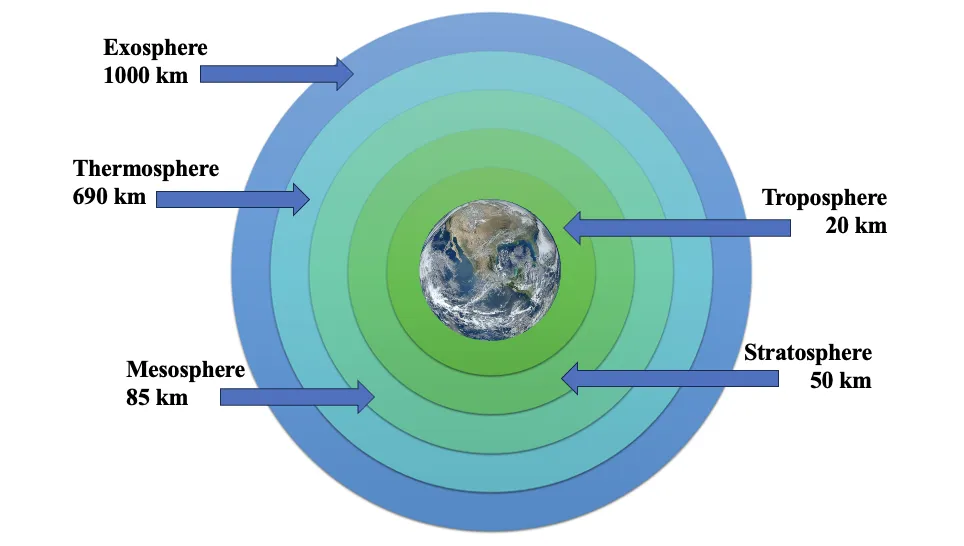
This type of environment refers to the different layers and conditions within the Earth’s atmosphere that surround it. Understanding atmospheric environments is crucial for studying weather patterns, climate change, and the interactions between the atmosphere and other Earth systems. Here are some major atmospheric environments:
1. Troposphere
- The troposphere is the lowest layer of the atmosphere, extending from the Earth’s surface to about 7–20 kilometres, depending on latitude and season.
- It is where weather phenomena occur, including the formation of clouds, precipitation, and most of the Earth’s atmospheric water vapour.
2. Stratosphere
- The stratosphere is the layer above the troposphere, extending about 10–50 kilometres above the Earth’s surface.
- It contains the ozone layer, which absorbs and filters out most of the Sun’s ultraviolet radiation.
3. Mesosphere
- The mesosphere is the layer above the stratosphere, extending from about 50 to 85 kilometres above the Earth’s surface.
- Meteors entering the Earth’s atmosphere burn up in the mesosphere.
4. Thermosphere
- The thermosphere is the layer above the mesosphere, extending from about 85 to 600 kilometres above the Earth’s surface.
- The International Space Station (ISS) and many satellites orbit within the thermosphere.
5. Exosphere
- The exosphere is the outermost layer of the atmosphere and is composed of low-density gases.
- It is thin and gradually transitions into the vacuum of space.
Also Read: Advanced Carbon Storage Technology And Its Potential Impact On The Environment
Underground Environments
Underground environments refer to the spaces and habitats beneath the Earth’s surface. It is essential for understanding geological processes, conserving unique ecosystems, and maximizing the use of subsurface resources. Here is a brief overview of underground environments:
- Caves and caverns are underground spaces that result from various geological processes. These environments often contain unique geological formations, such as stalactites, stalagmites, and underground rivers.
- Underground mining environments form when humans extract valuable minerals, metals, or resources beneath the Earth’s surface. These environments can be extensive networks of tunnels, shafts, and chambers.
- Underground aquifers are water-bearing geological formations located beneath the Earth’s surface. They store and supply groundwater, which is accessible through wells and boreholes.
Also Read: Best Apps For Environmental Education In The United States
Space Environments
Space environments refer to the conditions and surroundings beyond the Earth’s atmosphere, where celestial bodies exist. Here is a brief overview of space environments:
- Outer space refers to the vast expanse beyond the Earth’s atmosphere, where the vacuum of space exists. It has low atmospheric pressure, a temperature of almost absolute zero, and the absence of air and sound.
- Space stations are human-made structures designed for long-duration stays in space. Examples include the International Space Station (ISS), a research laboratory, and living quarters for astronauts.
- Microgravity, or zero gravity or weightlessness, is the condition experienced in space where gravitational forces decrease significantly.
- Planetary environments are the conditions on different planets, moons, and celestial bodies. Each planet or moon has its unique environment, including atmospheric composition, surface conditions, and geological features.
Also Read: Free Environmental Education Resources For US Teachers
Frequently Asked Questions
How many types of environment are there?
There are two main types: the natural (geographical) environment and the man-made environment. Some textbooks list three components by treating the human or social environment separately. A more detailed classification, like the one in this guide, recognises eight kinds: natural, built, aquatic, terrestrial, social, atmospheric, underground and space.
What are the components of the environment?
The environment has biotic (living) and abiotic (non-living) components. Geographically, its natural part is made of four spheres: the lithosphere (land), hydrosphere (water), atmosphere (air) and biosphere (living things).
What is the difference between biotic and abiotic components?
Biotic components are living things, such as plants, animals, fungi and bacteria. Abiotic components are the non-living conditions they depend on, such as sunlight, temperature, water, air and soil minerals. The two constantly affect each other: plants need sunlight and water, and in turn change the soil and the air.
What are examples of natural and man-made environments?
Natural: a forest, a river, a desert, a coral reef, a mountain range. Man-made: a city, a village, a dam, a farm, a factory, a park or a school.
Is a park or a farm a natural environment?
No. Both contain plants and soil, but people designed them and keep them going, so they are part of the man-made environment.
Conclusion
Understanding and appreciating the diverse types of environments is essential for recognizing the interconnectedness of ecosystems and human societies. Our planet’s functioning and the well-being of its inhabitants depend on all types of environments, from intricately interconnected natural ecosystems to beautifully designed environments to complex social dynamics. By understanding and appreciating the characteristics and significance of the various types of environment, we can work towards sustainable practices, effective conservation, and the creation of social structures that foster harmony between humans and the environment.
Also Read: Introduction to Environmental Management

“This guide on the types of environment is a comprehensive resource that sheds light on the diverse ecosystems that surround us. From terrestrial to aquatic environments, it offers valuable insights into the intricate balance of nature. Thank you for compiling such a thorough and informative guide!”
thanks for sharing
thanks for sharing
grateful blog
Informative post.
very knowledgeable post