
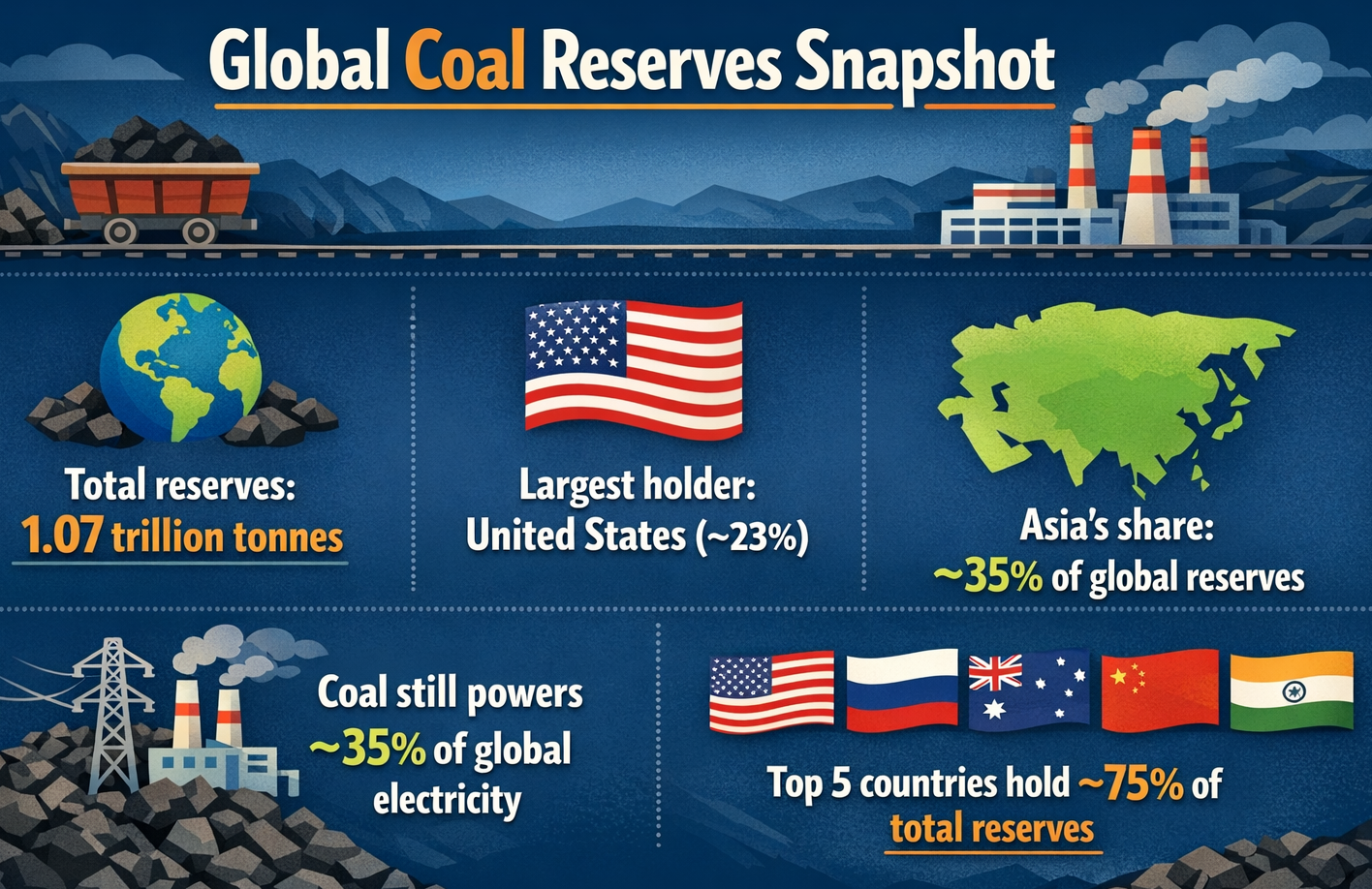
Despite the increase in renewable energy sources to meet global demand, coal remains an important part of our overall energy mix. As per the Energy Institute Statistical Review of World Energy 2024 and the USA Energy Information Administration (EIA), approximately 1.07 billion tonnes of coal are located in the world, of which the USA has the largest coal reserves in the world around 248 – 250 billion tonnes (23% of world total coal reserve) followed by Russia, Australia, China and India (all together represent significant part of global coal reserve).

An Overview of the World’s Largest Coal Reserves
To determine which countries have the largest coal reserves in the world, we must first define “coal deposits as an economic resource.” Coal deposits are a raw material that can be extracted from the Earth at an economical cost using existing technologies, and there is a significant imbalance in their distribution across continents and regions, with North America and Asia dominating.
The US has not only one of the world’s greatest quantities of total coal reserves, but also because of the wide variety of types available, bituminous, sub-bituminous, and lignitic, yet Russia and Australia have been developing many undeveloped coal reserves and play a very large role in the international coal market.
Also Read: Germany’s 364-Meter Wind Turbine In A Coal Mine Could Transform Renewable Power
Top Countries with the Largest Coal Reserves
Below is a simplified comparison of the leading countries:
| Country | Proven Reserves (Billion Tonnes) | Share of Global Reserves (%) |
|---|---|---|
| United States | 248.9 | ~23% |
| Russia | 162.2 | ~15% |
| Australia | 149.1 | ~14% |
| China | 143.2 | ~13% |
| India | 111.0 | ~10% |
Source: Energy Institute – Statistical Review of World Energy
Also Read: $22.7 Trillion Needed By India For Net-Zero By 2070, Coal Consumption To Increase Till 2047
The Importance of Asia in Coal Reserves
Asia occupies an important position in relation to coal reserves around the world, particularly because of the contribution from countries such as China and India.
- China not only boasts of massive reserves of coal but also happens to be the biggest producer and consumer of coal in the world.
- India has reserves of more than 111 billion tonnes of coal and is expanding fast in terms of production of the fuel.
Both these countries depend largely on coal to produce energy.
Also Read: India Saw 3% Drop In Coal Power Generation In 2025 Amid A Clean Energy Surge
Why the United States Has the Largest Coal Reserves
The United States holds the largest coal reserves in the world due to a combination of economic and geological reasons. The country’s coal reserves exist in many different areas, such as the Appalachian Basin, Powder River Basin, and Illinois Basin, providing geographical diversity and stability for extraction.
In addition, the U.S. has made substantial investments in mining technology that has enabled the country to classify a sizeable portion of its coal reserves as proven. While the country transitions away from coal as a primary energy source in favor of cleaner options, coal continues to be used as a backup energy source and a commodity for export.

Also Read: Global Coal Demand Set To Peak Before 2030, IEA Predicts
Coal Reserves vs. Coal Production
There is an essential difference between reserves and production. Not all countries with high reserves have high levels of coal production. For example:
- China is among the top producers despite ranking fourth in coal reserves.
- Australia produces a considerable quantity of coal for export purposes.
These are examples to prove the point that high reserves of coal in the world may not necessarily mean high production levels.
Also Read: Climate Tech Startups Driving The Global Energy Transition
Environmental Considerations
Even though there is an abundance of coal resources, the consumption of coal brings about certain environmental issues. Coal combustion is among the primary sources of CO₂ emissions, thus causing global warming.
The states with significant coal deposits are currently taking into consideration both economic and environmental factors by:
- Developing coal technology
- Promoting renewables
- Enforcing emission control measures
Also Read: Gulf Energy Sector Faces Huge $25 Billion Repair Challenge After War
What will be the Future?
So far, no one knows how long coal will be a viable energy source. All over the world, as long as people have access to cheap, plentiful coal, many countries have had to depend on it for secure electrical generation. Although there appears to be a gradual transition toward renewable energy globally, coal will probably still be a primary electricity source in developing countries for many years to come because of its low cost and wide availability.
Also Read: ₹40,176 Crore Approved For Two Major Hydropower Projects In Arunachal Pradesh
Lesser-Known Coal Facts Around the World
- The type of coal varies from one region to another: Anthracite, which contains the highest percentage of carbon, is less common; however, bituminous coal constitutes most of the world’s coal reserves.
- Lifespan of coal reserves is long: Based on current production levels, the world’s coal reserves should last for approximately 120–130 years, much longer than those of oil and natural gas.
- Geographical concentration is extreme: Nearly 80% of total proven coal reserves are distributed across only ten countries.
Also Read: Global Renewable Power Capacity Nears 50% In 2025: What The Milestone Really Means
Balancing Abundance and Sustainability
The majority of coal deposits are located in just a few nations, and the U.S. has the largest coal reserves in the world, which supply energy security and economic advantages; however, there is an associated level of pollution and environmental damage.
As the transition to cleaner energy takes place, coal will continue to have some role in the global energy market, and countries need to find a balance between using their natural resources and minimizing their negative environmental impacts, which will be needed so that future generations may benefit from a safe energy supply.
Also Read: India’s Power Demand Peaks At Five-Year High, Data Shows
FAQs
1. What country has the largest coal reserves in the world?
The United States is estimated to possess the largest coal reserves with around 248-250 billion tonnes of coal, which constitutes almost 23% of the global total.
2. Why is coal still significant even with the development of alternative sources of energy?
Coal is still significant due to its abundance, cost-effectiveness, and reliability, particularly for developing countries.
3. Are coal reserves spread evenly across the world?
Not at all; most coal reserves are located in only a few countries that account for almost 75% of the world’s total reserves.
Also Read: Power And Building Sectors Are Pushing U.S. Greenhouse Gas Emissions Higher, Report Finds

0 Comments