
Nuclear power has always been a divisive issue, with disputes about safety, environmental effects, and the future of energy supply. For decades, nuclear power plants in the United States have played an essential role in the energy landscape, generating a significant part of the country’s electricity. Despite the problems and controversy surrounding nuclear energy, there are compelling reasons to reconsider its place and potential in the US energy mix.
The Legacy of Power and Controversy
Both successes and failures define the history of nuclear power plants in the United States. The first commercial nuclear power plant, the Shipping Port Atomic Power Station in Pennsylvania, began operations in 1958, ushering in a new age of energy generation. Over the next several decades, the United States extended its nuclear fleet, with dozens more reactors coming online nationwide. However, the 1979 Three Mile Island accident and the 1986 Chernobyl tragedy placed a pall over the sector, heightening worries about the safety and environmental risks linked with nuclear energy. These accidents heightened regulatory scrutiny, increased public awareness, and slowed the development of new nuclear reactors.
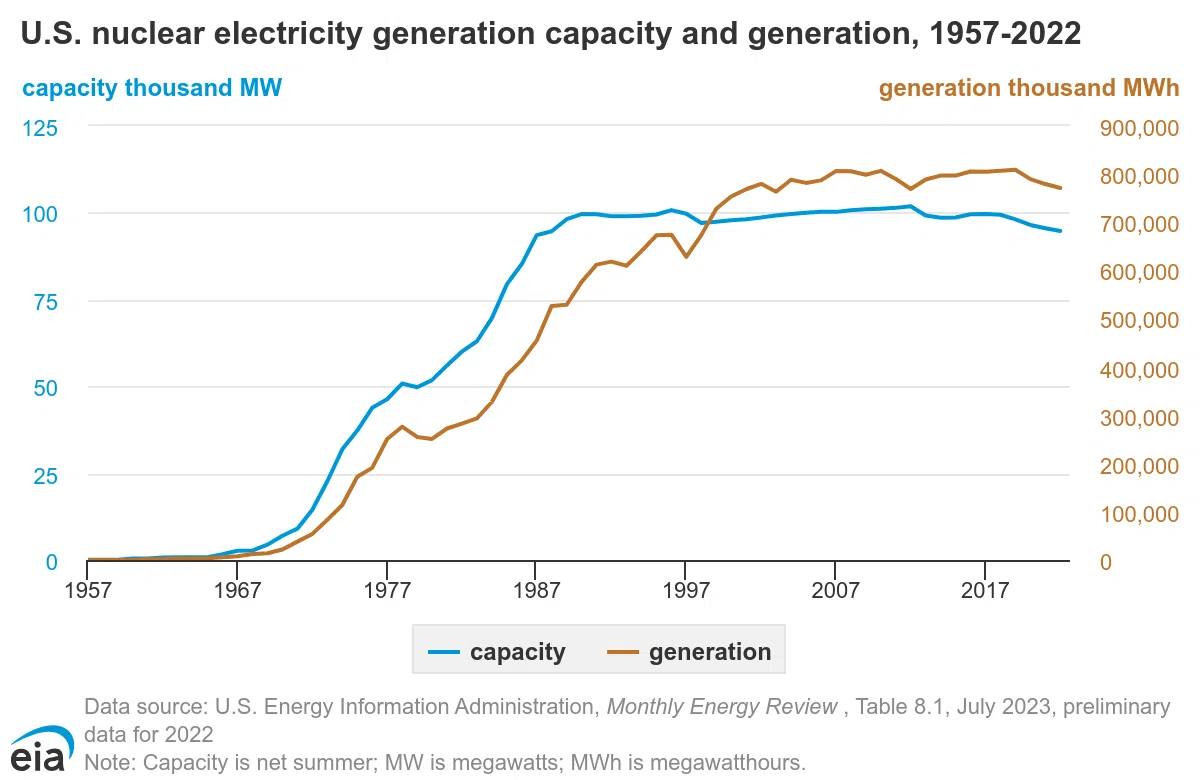
Source: EIA
Challenges and Opportunities
Today, the US nuclear fleet faces numerous obstacles. Many nuclear power facilities need help financially due to ageing infrastructure, high operating costs, and competition from low-cost natural gas and renewable energy sources. Several plants have closed prematurely in recent years, raising concerns about the loss of carbon-free power generation and its impact on climate change.
Despite these limitations, nuclear power has the potential to play an essential part in the United States’ energy transition. Nuclear energy is a low-carbon source of electricity that produces almost no greenhouse gases during operation. As the need to cut carbon emissions to combat climate change grows, nuclear power is vital for decarbonizing the electrical industry.
Furthermore, advances in nuclear technology hold the potential for safer and more efficient reactors. Next-generation designs, such as small modular reactors (SMRs) and advanced molten salt reactors, can overcome many of the issues raised by traditional nuclear plants, including safety, proliferation, and waste management.
Also Read: What Is Nuclear Power Waste And How It Is Processed?
Economic Considerations
While nuclear power confronts economic problems, such as high initial costs and competition from less expensive options, it also provides significant financial benefits to the communities where facilities are located. Nuclear power plants provide jobs, generate tax income, and help local economies, making them critical contributors to regional prosperity.
As of August 1, 2023, the United States had 93 nuclear reactors spread across 54 nuclear power plants in 28 states. Among these plants, 19 have a single reactor, 31 have two reactors, and 4 have three reactors. Since 1990, nuclear energy has consistently provided about 20% of the total annual electricity in the U.S.
In 2021, 33 countries had commercial nuclear power plants, with 15 of these countries deriving at least 20% of their total annual electricity generation from nuclear energy. The United States had the largest nuclear power generation capacity and produced more nuclear electricity than any other country.
Furthermore, nuclear power provides energy security by lowering reliance on imported fossil fuels, susceptible to price volatility and geopolitical threats. By diversifying the energy mix and improving grid stability, nuclear energy can help assure a consistent electricity supply, even during high demand or outages in other sources.
List of Nuclear Power Plants in the US: Locations and Capacities
Power Station |
Unit |
Capacity (MW) |
Location |
Arkansas Nuclear One (ANO) |
2 |
1,839 |
Clark Township, Pope County, near Russellville, Arkansas |
Beaver Valley Power Station |
2 |
1,738 |
Shippingport, Beaver County, Pennsylvania |
2 |
2,330 |
||
Browns Ferry Nuclear Power Plant |
3 |
3,300 |
Athens, Limestone County, Alabama |
2 |
1,858 |
Smithville Township, Brunswick County, North Carolina, near Southport, North Carolina |
|
Byron Nuclear Generating Station |
2 |
2,300 |
Rockvale Township, Ogle County, near Byron, Illinois |
Callaway Plant |
1 |
1,190 |
|
Calvert Cliffs Nuclear Power Plant (CCNPP) |
2 |
1,735 |
Calvert County, near Lusby, Maryland |
Catawba Nuclear Station |
2 |
2,258 |
York, York County, South Carolina |
Clinton Power Station |
1 |
1,043 |
Harp Township, DeWitt County, near Clinton, Illinois |
Columbia Generating Station |
1 |
1,107 |
Benton County, near Richland, Washington |
Comanche Peak Nuclear Power Plant |
2 |
2,367 |
Somervell County, near Glen Rose, Texas |
Cooper Nuclear Station |
1 |
770 |
Nemaha County, near Brownville, Nebraska |
Davis–Besse Nuclear Power Station |
1 |
965 |
Carroll Township, Ottawa County, near Oak Harbor, Ohio |
Diablo Canyon Power Plant |
2 |
2,240 |
San Luis Obispo County, California |
Donald C. Cook Nuclear Plant |
2 |
2,069 |
Lake Township, Berrien County, near Bridgman, Michigan |
Dresden Nuclear Power Plant |
2 |
1,734 |
Goose Lake Township, Grundy County, near Morris, Illinois |
Edwin Irby Hatch Nuclear Power Plant |
2 |
1,759 |
Baxley, Appling County, Georgia |
Enrico Fermi Nuclear Generating Station |
1 |
1,122 |
Frenchtown Charter Township, Monroe County, Michigan |
Ginna Nuclear Power Plant |
1 |
610 |
|
Grand Gulf Nuclear Station |
1 |
1,419 |
Claiborne County, near Port Gibson, Mississippi |
Robinson Nuclear Plant |
1 |
735 |
Darlington County, near Hartsville, South Carolina |
Hope Creek Nuclear Generating Station |
1 |
1,191 |
Lower Alloways Creek, Salem County, New Jersey |
James A. FitzPatrick (JAF) Nuclear Power Plant |
1 |
838 |
Scriba, Oswego County, near Oswego, New York |
Joseph M. Farley Nuclear Generating Plant |
2 |
1,711 |
Dothan, Alabama |
LaSalle County Nuclear Generating Station |
2 |
2,238 |
Brookfield Township, LaSalle County, near Marseilles, Illinois |
Limerick Generating Station |
2 |
2,264 |
Limerick Township, Montgomery County, Pennsylvania |
McGuire Nuclear Station |
2 |
2,200 |
Mecklenburg County, near Huntersville, North Carolina |
Millstone Nuclear Power Station |
3 |
2,102 |
Waterford, New London County, Connecticut |
Monticello Nuclear Generating Plant |
1 |
647 |
Monticello, Wright County, Minnesota |
Nine Mile Point Nuclear Station |
2 |
1,764 |
Scriba, Oswego County, New York |
North Anna Nuclear Generating Station |
2 |
1,875 |
Louisa County, near Mineral, Virginia |
Oconee Nuclear Station |
3 |
2,538 |
Oconee County, near Seneca, South Carolina |
Palo Verde Generating Station |
3 |
3,942 |
Tonopah, Arizona |
Peach Bottom Atomic Power Station |
2 |
2,234 |
|
Perry Nuclear Power Plant |
1 |
1,240 |
North Perry, Lake County, Ohio |
Point Beach Nuclear Plant |
2 |
1,182 |
Town of Two Creeks, Manitowoc County, near Two Rivers, Wisconsin |
Prairie Island Nuclear Generating Plant |
2 |
1,114 |
Red Wing, Goodhue County, Minnesota |
Quad Cities Generating Station |
2 |
1,774 |
Cordova Township, Rock Island County, near Cordova, Illinois |
River Bend Nuclear Generating Station |
1 |
967 |
West Feliciana Parish, near St. Francisville, Louisiana |
St. Lucie Nuclear Power Plant |
2 |
1,678 |
Port St. Lucie, St. Lucie County, Florida |
Salem Nuclear Power Plant |
2 |
2,332 |
Lower Alloways Creek, Salem County, New Jersey |
Seabrook Nuclear Power Plant |
1 |
1,247 |
Seabrook, New Hampshire |
Sequoyah Nuclear Plant |
2 |
2,278 |
Hamilton County, near Soddy-Daisy, Tennessee |
Harris Nuclear Plant |
1 |
964 |
New Hill, Wake County, North Carolina |
South Texas Project Electric Generating Station |
2 |
2,560 |
Matagorda County, near Bay City, Texas |
Surry Power Station |
2 |
1,638 |
Surry County, near Rushmere, Virginia |
Susquehanna Steam Electric Station |
2 |
2,429 |
Salem Township, Luzerne County, Pennsylvania |
Turkey Point Nuclear Generating Station |
2 |
1,658 |
|
Virgil C. Summer Nuclear Power Station |
1 |
973 |
Fairfield County, South Carolina |
Alvin W. Vogtle Electric Generating Plant |
3 |
3,419 |
Burke County, Georgia |
Waterford Steam Electric Station |
1 |
1,168 |
Killona, St. Charles Parish, Louisiana |
Watts Bar Nuclear Plant |
2 |
2,288 |
Rhea County, near Spring City, Tennessee |
Wolf Creek Generating Station |
1 |
1,160 |
Hampden Township, Coffey County, near Burlington, Kansas |
In conclusion, nuclear power plants have been a staple of the US energy landscape for decades, providing millions of Americans with dependable, low-carbon electricity. While the sector faces economic viability and public image obstacles, nuclear energy has excellent promise as a crucial contributor to a sustainable energy future. By embracing innovation, reducing regulation, encouraging public acceptability, and incentivizing deployment, the United States can realize nuclear power’s full potential and ensure that it remains an essential component of the country’s energy mix for future generations. As we face the pressing challenge of climate change, nuclear power is poised to play a vital role in enabling a cleaner, more sustainable future.
Also Read: Nuclear Waste Disposal Challenges

Your list is missing the Nuclear Facility in Springfield. It provides renewable energy for that state and all the surrounding states.
Morning Mr , i will work in your central electrical because i come to obtain a Master electric energie this year.