
Updated 13 November 2026
Measurement | Kilometres | Miles | Inches |
|---|---|---|---|
Equatorial circumference | 40,075 | 24,901 | about 1.578 billion |
Polar (meridional) circumference | 40,008 | 24,860 | about 1.575 billion |
Equatorial diameter | 12,756 | 7,926 | about 502 million |
Polar diameter | 12,714 | 7,900 | about 500 million |
Mean radius | 6,371 | 3,959 | about 251 million |
Despite appearing to be a stable and unchanging planet, the Earth is subject to several dynamic processes that can slowly modify its dimensions. One debate emerges whether the Earth’s circumference is decreasing or increasing. To answer this, let’s first understand the Earth circumference and the forces influencing possible alterations.
Earth’s Actual Circumference
The Earth circumference is not a set value because of its oblate spherical shape, which means it is slightly flattened in the poles and bulging at the equator. This form yields two basic circumference measurements.
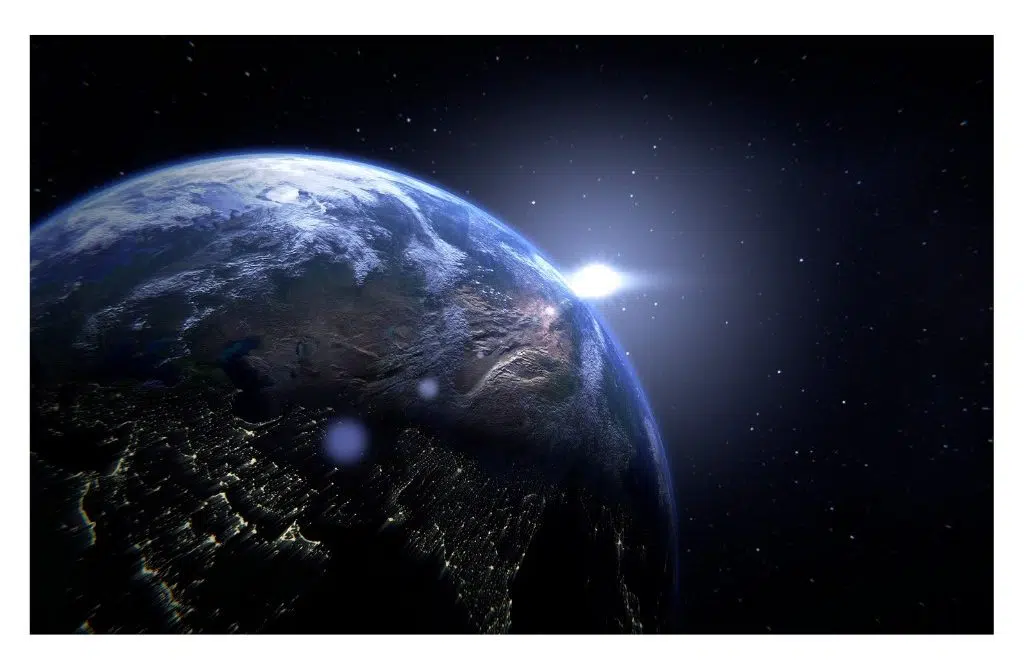
- Equatorial circumference is approximately 40,075 kilometres (24,901 miles).
- The polar circumference is approximately 40,008 kilometres (24,860 miles).
These measurements follow from the Earth’s radius, roughly 6,378 kilometres (3,963 miles) at the equator and 6,357 kilometres (3,950 miles) at the poles. The difference of about 21 km is caused by the planet’s rotation, which flings material outwards at the equator. The mean radius is about 6,371 km (3,959 miles).
How Was the Earth’s Circumference First Measured?
The first known measurement was made around 240 BC by the Greek scholar Eratosthenes, head of the library at Alexandria in Egypt. He knew that at noon on the summer solstice the Sun shone straight down a well at Syene (modern Aswan), while at Alexandria, roughly 5,000 stadia to the north, a vertical stick cast a shadow at an angle of about 7.2 degrees, one-fiftieth of a full circle. He reasoned that the distance between the two cities must therefore be one-fiftieth of the Earth’s circumference, giving 250,000 stadia. Historians disagree about the exact length of the stadion he used, but most conversions put his result within a few per cent to about 15% of the true value, a remarkable result for a stick, a shadow and some geometry.
Later scholars, including Posidonius in Greece and Aryabhata in India, made their own estimates. Today the figure is measured to within millimetres using satellites.
Is Earth Circumference Shrinking or Expanding?
The Earth’s size does not change significantly during geological time; it remains relatively steady. However, complex processes that entail material addition and removal affect its dimensions. Plate tectonics keeps this in balance: oceanic crust is constantly created at mid-ocean ridges and then subducted back into the mantle at convergent boundaries. This recycling process ensures that the planet’s surface area remains balanced. Volcanic activity can deposit fresh material into the crust, but erosion and weathering wear it away.
Satellite data and global positioning systems (GPS) accurately measure the Earth’s size and variations over time. One crucial tool is Very Long Baseline Interferometry (VLBI), which can estimate distances between places on the Earth’s surface with millimetre accuracy. Studies have shown that tectonic activity moves the plates relative to each other, which changes distances between places but not the overall size of the planet. For example, the development of the Mid-Atlantic Ridge widens the Atlantic Ocean by around 2.5 centimetres (1 inch) per year. On the other hand, the Pacific Ocean is diminishing as the Pacific Plate subducts beneath other plates.
Additionally, Earth gains a small amount of mass from cosmic dust and meteorites: a 2021 study of Antarctic snow (Rojas and colleagues) estimated that about 5,200 tonnes of micrometeorite dust reach the surface each year, while the planet also loses some light atmospheric gases, such as hydrogen and helium, to space. Both are negligible compared with the Earth’s mass of about six thousand billion billion tonnes. Overall, these processes change the Earth’s circumference exceedingly slowly. The overall impact of these processes over millions of years can be enormous, yet the changes on a human timeline are minimal. According to a 2011 study by a NASA Jet Propulsion Laboratory team led by Xiaoping Wu, published in Geophysical Research Letters, the Earth is not noticeably growing or contracting. The study combined satellite laser ranging, VLBI, GPS and other satellite measurements and found that the Earth’s average radius is changing by about 0.1 millimetre per year, roughly the thickness of a human hair. This slight fluctuation is within the measurement margin of error and is considered inconsequential regarding long-term impacts.
Factors Influencing Earth Circumference
Several natural processes can alter the earth’s circumference, but the changes are usually minute over short geological timescales:
- Tectonic Activity: The motion of tectonic plates can cause shifts in the Earth’s surface. For example, subduction (the movement of one plate under another) can reduce the earth’s circumference locally, whereas seafloor spreading at mid-ocean ridges can expand it.
- Isostatic Rebound: Since the previous Ice Age, many locations covered by vast ice sheets are still rebounding (rising) as the ice’s weight has been removed. This process can affect the form and circumference of the Earth.
- Erosion and Deposition: While these processes largely influence local topography, mass redistribution can have minimal effects on the Earth’s overall structure.
- Global Warming: The melting of glaciers and polar ice caps, along with the thermal expansion of seawater, might cause sea levels to rise, potentially altering the mass distribution and the shape of the Earth.
In conclusion, while numerous dynamic processes such as tectonic activity, isostatic rebound, and erosion can produce tiny local changes in the Earth’s circumference, the Earth’s overall circumference is relatively stable. Modern geodetic techniques have revealed that the Earth’s average radius fluctuates by less than a millimetre yearly, showing no major long-term expansion or contraction. Thus, the Earth’s diameter can practically be regarded as constant over human periods. Because the crust created at mid-ocean ridges is balanced by crust destroyed at subduction zones, the Earth’s dimensions stay essentially constant.
Also Read: The Hidden World Inside Us: An Overview Of Human Microbes

Hat die Abkühlung des Erdkerns -Schrumpfung – keinen Einfluss auf den Erddurchmesser / -Umfang?
The unpredictable nature of random increases makes them a form of irregular change, fitting the definition of fluctuation.