
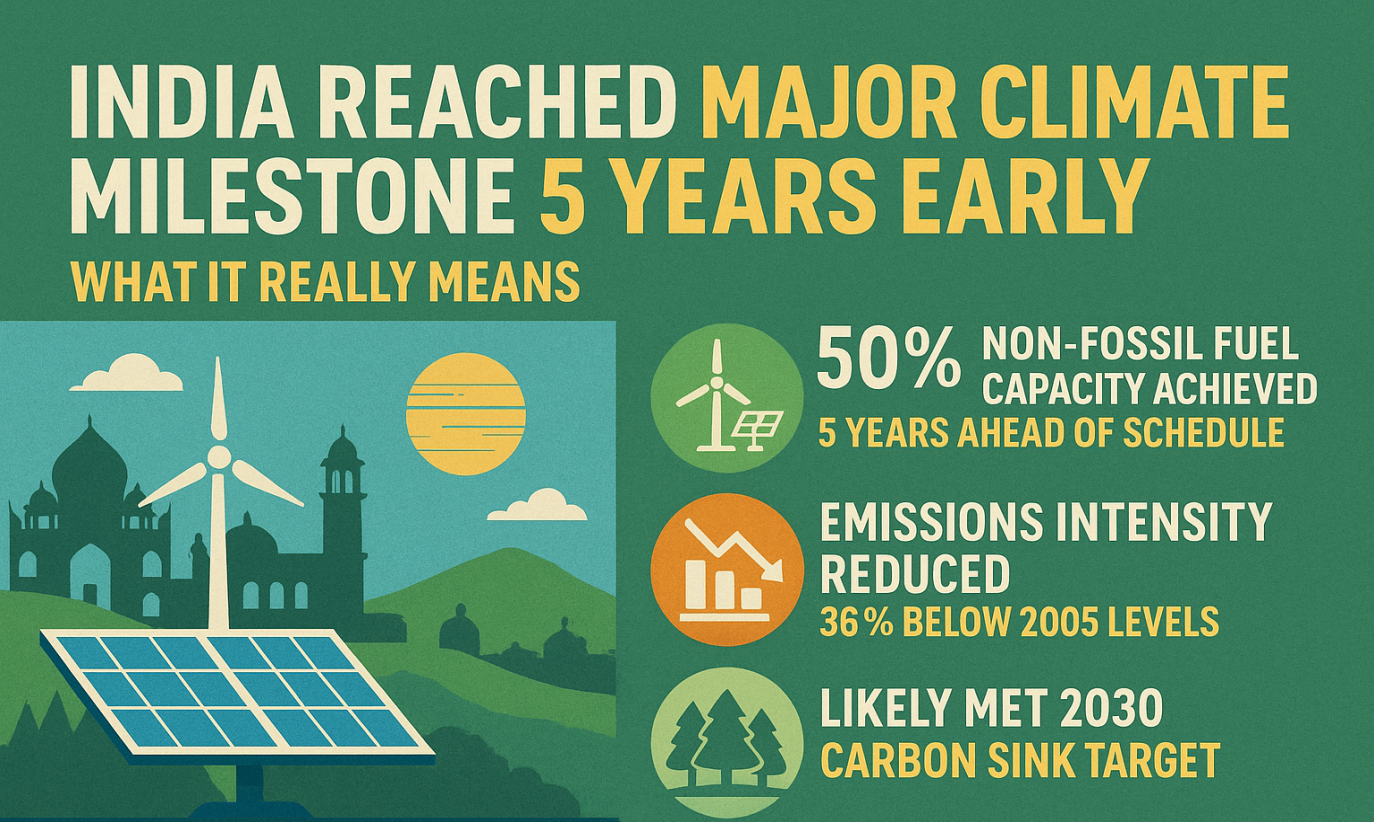
India reached a major climate milestone 5 years early, as it has surpassed 50% of its installed electricity generation capacity from non-fossil fuel sources, five years ahead of its 2030 target under the Paris Agreement, marking a significant climate milestone. This milestone, announced in July 2025, is indicative of India’s rapid transformation to clean energy, with 242.78 GW of its total 484.82 GW capacity derived from nuclear, large hydropower, wind, and solar electricity. In addition to lowering emissions intensity by 45% from 2005 levels and establishing a carbon sink of 2.5–3 billion tonnes of CO2 equivalent through forest cover, this accomplishment satisfies one of India’s three 2030 climate targets. Although this development is praiseworthy, it raises questions about its broader implications for India’s energy sector and the global climate goals. As India reached a significant climate milestone 5 years early, this article examines its importance, drawbacks, and future implications.
How Has India Achieved 50% Non-Fossil Fuel Capacity?
India reached a major climate milestone 5 years early and has achieved 50% non-fossil fuel capacity thanks to the country’s tremendous expansion in renewable energy, especially wind and solar. Solar contributed 24 GW, the most significant yearly addition to date, to India’s almost 30 GW of renewable energy in 2024. India has stepped up its efforts after falling short of its 2022 objective of 175 GW of renewable capacity. By June 2025, it is expected to have 184.6 GW of renewables (excluding large hydroelectric projects). The current total of non-fossil sources, including nuclear and hydropower, is 242.78 GW. Through subsidies and expedited procedures, government programs, including PM-KUSUM, PM Surya Ghar, and Wind-Solar Hybrid initiatives, have encouraged this expansion. Since solar and wind electricity rates are currently among the lowest in India, renewable energy sources are becoming increasingly competitive. To meet growing energy demand, India plans to install 80 GW of coal-fired capacity by 2032, underscoring its continued reliance on fossil fuels.

Also Read: IRENA: Global Renewable Energy Growth Remains Uneven Despite 15% Rise
What Is the Difference Between Capacity and Actual Generation?
Not all of India’s electricity is clean, despite 50% of its installed capacity being non-fossil. The maximum possible production of power plants is referred to as installed capacity; however, actual generation is contingent upon several variables, including weather, seasonality, and grid stability. According to the Central Electricity Authority, 28% of electricity generation in May 2025 came from non-fossil sources, such as nuclear and hydropower. Just 22% of India’s overall energy consumption comes from electricity; the remaining energy is derived from the direct use of fossil fuels, such as coal, oil, and gas. As a result, non-fossil sources make up only 6% of India’s overall energy mix, which is comparable to the global average.
Given that India’s energy needs are expected to expand 1.5 times faster than the global average over the next three decades, this disparity highlights the intermittent nature of renewable energy sources and the challenge of scaling clean energy to meet those needs.

Also Read: How Energy Instability Shapes Economic And Environmental Policy
How Close Is India to Its Carbon Sink and Emissions Intensity Goals?
India’s other 2030 climate goals are on pace to be met or surpassed. The goal of using forests and tree cover to absorb 2.5–3 billion tonnes of CO2 equivalent is likely to be achieved or nearly so. According to the India State of the Forest Report (ISFR), India added 2.29 billion tonnes by 2021, with an average yearly increase of 150 million tonnes between 2017 and 2021. The 2023 ISFR, scheduled for later in 2025, may confirm that India has surpassed the 2.5 billion-tonne mark if this trend continues. In terms of emissions intensity, by 2020, India had cut emissions per GDP unit by 36% from 2005 levels. The 45% reduction objective by 2030 is attainable with consistent effort, and if GDP growth keeps up at 8% per year, it may even be reached before 2025. Although detractors contend that more ambitious goals are required to align with a 1.5°C pathway, these accomplishments demonstrate India’s capacity to meet modest, self-set targets.
Also Read: India Needs $1.5 Trillion By 2030 For Climate And Energy Targets: Deloitte
What Challenges Remain for India’s Climate Goals?
India still faces several obstacles despite these achievements. Its energy system still relies heavily on coal, with fossil fuels accounting for 73% of electricity production in 2023, compared to 82% in 2015. Plans to increase coal capacity by 80 GW by 2032 highlight the conflict between decarbonization and energy demand. Because renewable energy sources are intermittent, grid infrastructure and battery storage require investment, two sectors where advancements are slow. Furthermore, resource limitations are highlighted by India’s conditional NDC, which emphasizes its need for foreign funding and technology assistance. India’s targets are rated as “Highly Insufficient” for a 1.5°C scenario by the Climate Action Tracker, indicating that more robust commitments are required. India’s position as the third-largest emitter in the world is further complicated by its increasing emissions, which are expected to rise from 7% to 10% of global CO2 emissions by 2030.
| India’s Progress on 2030 Paris Agreement Targets | ||
| Target | Goal by 2030 | Progress as of 2025 |
| Non-Fossil Fuel Capacity | 50% of installed electricity capacity | Achieved (50.1%, 242.78 GW of 484.82 GW) |
| Emissions Intensity | 45% reduction from 2005 levels | 36% reduction by 2020, on track for 2030 |
| Carbon Sink | 2.5–3 billion tonnes CO2 equivalent | 2.29 billion tonnes by 2021, likely achieved by 2023 |
Also Read: The Decentralized Renewable Energy Grid: Storage, Microgrids, And Virtual Power Plants
Frequently Asked Questions (FAQs)
Q1. What does the 50% non-fossil fuel capacity milestone mean for India’s energy mix?
This indicates that more than half of India’s installed electrical capacity (242.78 GW out of 484.82 GW) comes from non-fossil sources, such as solar, wind, hydro, and nuclear energy. However, because renewables are intermittent and fossil fuels are still used to meet other energy demands, they account for only 28% of actual electricity output and 6% of total energy consumption.
Q2. Has India achieved its carbon sink target?
With 2.29 billion tonnes added by 2021, India is probably on track to meet or surpass its objective of 2.5–3 billion tonnes of CO2 equivalent carbon sinks. Updated data from the 2023 ISFR, anticipated in 2025, will verify whether this objective has been met earlier than initially expected.
Q3. Why are India’s climate targets considered insufficient by some?
India’s aims are rated as “Highly Insufficient” by the Climate Action Tracker due to their inconsistency with the 1.5°C Paris Agreement pathway. Critics contend that, given its growing contribution to global CO2 emissions (7% in 2021, expected to reach 10% by 2030), India needs more ambitious targets to drastically cut emissions, even though it is meeting its modest, self-set goals.
Also Read: Generating Renewable Energy Through Anaerobic Digestion Of Organic Waste

0 Comments