
Famous for their vivid and brilliant plumage, birds-of-paradise emit biofluorescent light, captivating both scientists and birdwatchers. Mostly found in Australia, parts of Indonesia, and New Guinea, these exotic birds are well-known for their eye-catching feather patterns and intricate courtship rituals. Recent studies have shown an even more captivating characteristic, though: a large number of these birds are biofluorescent.
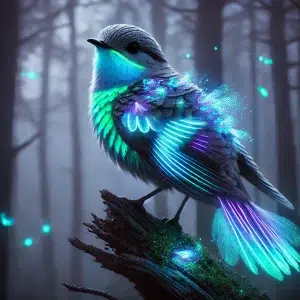
According to a study that was published in the Royal Society Open Science journal, biofluorescence is present in 37 out of 45 known species of birds-of-paradise. This indicates that specific body parts absorb blue or UV light and subsequently release it at a lower frequency, sometimes in green, teal blue, or green-yellow hues. The finding casts doubt on preconceived notions about avian eyesight and raises the possibility that these birds perceive the world in previously undiscovered ways.
Birds-of-Paradise Emit Biofluorescent Light: What is Biofluorescence?
Absorption of high-energy light wavelengths (such as blue or ultraviolet light) and the subsequent re-emission of the light at longer visible spectrum wavelengths is known as biofluorescence. This is not the same as bioluminescence, which occurs in deep-sea fish or fireflies when an organism produces its own light through chemical interactions.
Numerous animal groups, including some fish species, amphibians, reptiles, and even a few birds, like puffins and parrots, have been shown to exhibit the phenomenon of biofluorescence. But up until now, little is known about its function in avian behavior and communication.
The Discovery: Birds-of-Paradise and Their Glowing Feathers
Researchers looked at preserved specimens from the American Museum of Natural History‘s ornithology collection to determine whether birds-of-paradise exhibit biofluorescence. They examined and documented the wavelengths and intensities of light emitted by various bird body parts using blue light in a dark room. In certain instances, the degree of fluorescence was also assessed using ultraviolet light.
The outcomes were remarkable. Males of 21 species showed biofluorescence in their tail feathers, head, neck, belly, or facial wattles, which are fleshy lobes. The inside of the mouths and throats of these species, along with those of 16 other species, also showed fluorescence. The fluorescence patterns of 36 of these species’ females, and probably all 37 of them, were strikingly similar, albeit more restricted to the chest, belly, and feathers forming an eye stripe on the head.
When paired with their already spectacular natural coloration, the biofluorescent colors that were released—which ranged from teal blue to bright green and green-yellow—created an even more vivid display.
Also Read: Marine Animals Ingest And Excrete Microplastics, Amplifying Risks To Ocean Ecosystems
Why Do Birds-of-Paradise Glow?
Mate Attraction
Male birds-of-paradise are renowned for their intricate courtship rituals, which frequently include coordinated dances, displays of feathers, and even the creation of sounds. Researchers suggest that birds-of-paradise emit biofluorescent light that enhances these displays by emphasizing important visual cues.
For instance, during displays, males of the genus Lophorina have been seen opening their lips wide, revealing the biofluorescent patches within. This illuminating aspect could draw in potential mates and add drama to the presentation, especially when contrasted with their surrounding dark plumage.
Camouflage or Signaling
The function of biofluorescence in female birds, however, is still unknown. While males use strong signals for courtship, females may employ biofluorescence for different reasons. The brilliant patterns on female birds, especially on the belly and chest, are thought to aid in camouflage. They might be better able to blend in with their environment and avoid predators while nesting as a result.
Social signalling is another potential use. Birds-of-paradise emit biofluorescent light, which may help in species recognition or communication because many birds-of-paradise live in dense tropical forests, especially in low-light conditions where UV and blue light are more noticeable.
Evolutionary Advantage
According to the study, there was no biofluorescence in species belonging to the genera Phonygammus, Manucodia, and Lycocorax. This implies that the characteristic was probably present in the common ancestor of all birds-of-paradise but was lost in some evolutionary lines. The remaining species’ continued fluorescence suggests that it offers a selective advantage, most likely in terms of mate selection and reproductive success.
Also Read: 2020 Marked The Greenest Year In Modern Satellite Records, Study Finds
Implications of the Study
Our knowledge of avian vision and communication could be greatly impacted by the discovery of biofluorescence in birds-of-paradise. Because of their sophisticated visual systems, birds can frequently see beyond what is visible to humans. Specialized cone cells in the eyes of many species, including birds-of-paradise, enable them to detect ultraviolet light. This suggests that they most likely interpret biofluorescent signals in a way that is not visible to the naked eye.
Additionally, this discovery opens new avenues for investigating the function of biofluorescence in other bird species. The fact that fluorescence has now been observed in several bird families suggests that this property may be more common than previously believed. Additional research may shed light on how fluorescence has evolved, how it functions in birds’ natural habitats, and how it interacts with other visual cues.
From a conservation perspective, this discovery further emphasizes the significance of protecting natural areas. Artificial lights and deforestation may interfere with the natural light conditions required for biofluorescence to function efficiently. If birds-of-paradise emit biofluorescent light for mating or communication, habitat degradation may have unanticipated effects on their populations.
Final Words
The discovery that birds-of-paradise emit biofluorescent light broadens our knowledge of these already intriguing animals. Their capacity to glow in the presence of blue and UV light implies that their visual environment is significantly more complex than we previously thought. This discovery casts doubt on how we currently understand avian signalling and raises fresh questions about the potential prevalence of biofluorescence in birds.
With further investigation, researchers might find even more cryptic visual adaptations in creatures like birds. The investigation of biofluorescence in birds-of-paradise serves as a reminder that there are still many unsolved mysteries in nature. One question still stands as our knowledge of avian biology grows: What other secrets might birds be hiding?
Also Read: Symbiotic Relationships In The Amazon’s Unique Wildlife

0 Comments