
The early January heatwave in Australia was not a fluke of bad luck or a random quirk of summer weather. Climate scientists now say, with high confidence, that human-driven climate change dramatically increased the likelihood and intensity of this heat event. What Australians experienced in the first weeks of January was a preview of a warming future arriving sooner than expected.
Heatwaves have always been part of Australia’s climate story. But this one came early, stayed longer, and burned hotter, a pattern that scientists say fits neatly into the fingerprint of global warming.
What Happened During the Early January Heatwave in Australia
Temperatures That Refused to Behave Normally
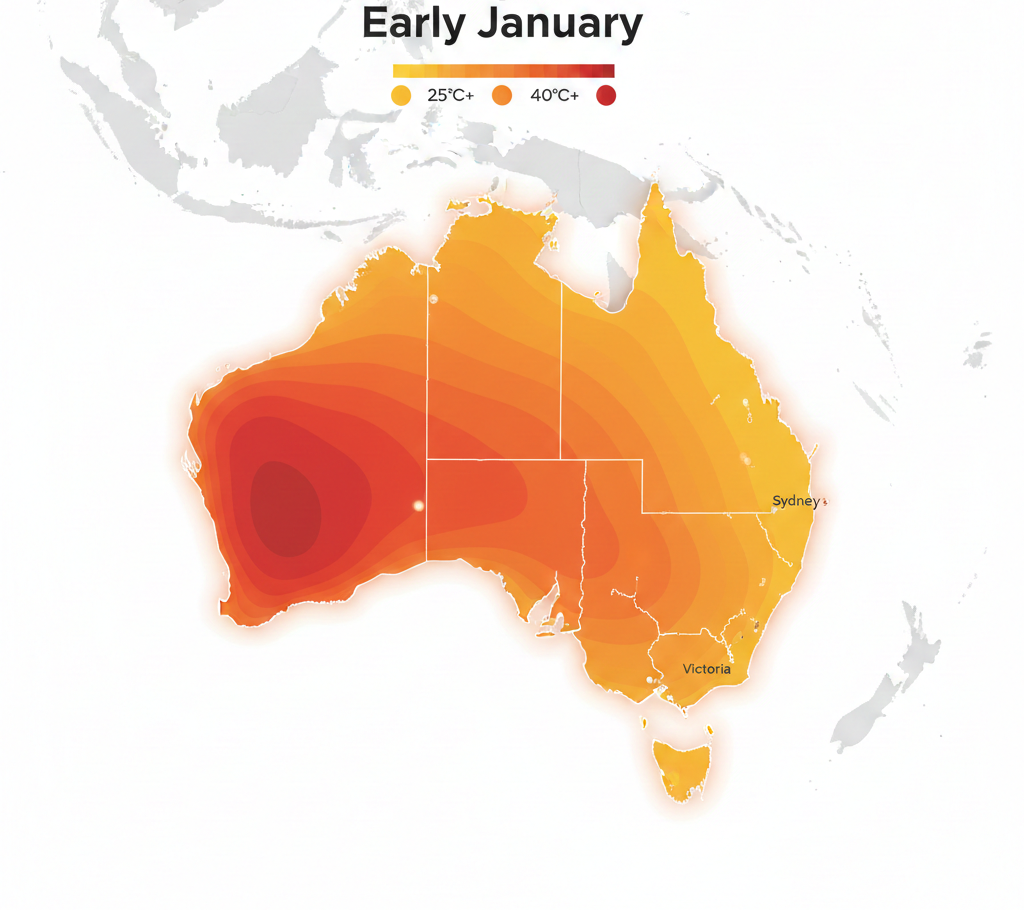
The early January heatwave in Australia swept across multiple states, pushing temperatures well beyond historical averages for the start of summer.
- Parts of Western Australia, South Australia, and New South Wales recorded temperatures above 40°C→ (Bureau of Meteorology)
- Night-time temperatures remained unusually high, preventing bodies and infrastructure from cooling. (Bureau of Meteorology)
This wasn’t just daytime discomfort. It was continuous thermal stress.
Why “Early” Matters More Than It Sounds
Heatwaves later in summer are dangerous. Heatwaves this early are worse. Early-season heat hits like an ambush. People aren’t ready, houses aren’t set up for it, bodies haven’t had time to adjust, and many emergency systems are still half-asleep.
That’s why public health experts have been warning for years that these early heatwaves tend to leave a harsher imprint on health than ones that arrive later in the season. The early January heatwave in Australia fits this high-risk profile almost perfectly.
Also Read: How Indian Cities Are Becoming Heat Islands: What The Data Is Quietly, Relentlessly Showing
How Scientists Linked the Heatwave to Climate Change
Event Attribution: Turning Weather Into Evidence
Within weeks of the heatwave, climate scientists conducted an event attribution study, a method that compares today’s climate with a simulated world without human-driven warming.
The results were clear:
This doesn’t mean climate change caused the heatwave outright. It means it loaded the dice, making extreme heat far more probable.
Also Read: Earth Is Heating Faster Than Thought—But Only Better Models Can Reveal How Much
A Warmer Baseline Changes Everything

Australia has already warmed by approximately 1.5°C since 1910. That baseline warming means:
- Heatwaves start sooner
- Temperatures climb higher
- Recovery between hot days becomes harder
The early January heatwave in Australia didn’t break the rules of physics. It followed them in a warmer world.
Also Read: Deadly Heatwaves Loom Over Asia’s Megacities, Says UN Report
Why Australia Is Especially Vulnerable to Early Heatwaves
Geography, Atmosphere, and Feedback Loops
Australia sits at the intersection of several climate amplifiers:
- A large landmass that heats quickly
- Dry soils that retain less moisture
- Subtropical high-pressure systems that trap heat
This is why the early January heatwave in Australia is not an isolated episode; it’s part of a trend.
Also Read: UN Warns Middle East Is Heating Faster Than The Rest Of The World
The El Niño Factor (But Not the Whole Story)

Yes, El Niño was in the room this summer, but scientists keep insisting on a crucial twist. El Niño turns up the dial; climate change lifts the entire thermostat. Even if El Niño vanished tomorrow, heatstorms like this would now stalk us far more often than they did a few decades back.
Also Read: India’s Agriculture At High Risk From Heat Stress, Says UN ESCAP Report
Impacts: People, Ecosystems, and Infrastructure
Hospitals across affected regions reported spikes in:
- Heat exhaustion
- Dehydration
- Cardiovascular stress
Older adults, outdoor workers, and people with chronic illnesses were most vulnerable.
Early heatwaves strain systems before seasonal staffing and planning fully kick in, a problem highlighted again during the early January heatwave in Australia.
Environmental and Economic Stress

Extreme heat also reshapes landscapes:
- Increased bushfire risk earlier in the season
- Crop stress and reduced yields
- Wildlife dehydration and habitat loss
Australia’s environment department warns that heatwaves are now the most deadly natural hazard in the country, and the early January heatwave in Australia reinforced this reality.
Also Read: Heatwaves Drove A 9% Surge In India’s Power Demand In 2024, New Study Finds
The Numbers Behind the Heat
| Indicator | Data | Source |
|---|---|---|
| Increase in likelihood due to climate change | 3–5× | https://www.worldweatherattribution.org |
| Australia warming since 1910 | ~1.5°C | https://www.bom.gov.au |
| Global warming level | ~1.2°C | https://www.ipcc.ch |
| Heatwave frequency since 1950s | ~2× | https://www.csiro.au |
| Leading cause of weather-related deaths in Australia | Heatwaves | https://www.environment.gov.au |
Numbers like these explain why scientists no longer treat events like the early January heatwave in Australia as anomalies.
Also Read: Hidden Climate Danger: Oceans Quietly Releasing Powerful Heat-Trapping Gas, Study Finds
What This Means for the Future
Earlier Heat Is Becoming the New Normal
Climate projections show that, without rapid emissions cuts:
- Heatwaves will arrive earlier
- Last longer
- Occur more often
The IPCC warns that extreme heat events will intensify with every fraction of a degree of warming.
The early January heatwave in Australia is a snapshot of that trajectory.
Adaptation Has Limits
Australia has made strides in heat warnings, urban cooling, and emergency planning, but adaptation can only go so far.
- You can’t air-condition ecosystems.
- You can’t reschedule seasons.
- You can’t adapt endlessly to rising heat.
- Ultimately, reducing fossil fuel emissions is the only way to stop loading the climate dice.
Also Read: Rising Heat Claims One Life Every Minute Worldwide, Major Report Finds
Conclusion: Heatwaves Don’t Happen in Isolation Anymore
The early January heatwave in Australia was not just an uncomfortable start to summer. It was a scientifically documented signal of a stressed climate system.
Human-driven climate change didn’t whisper in this event. It spoke clearly through probabilities, temperature records, and strained systems. If early January now looks like mid-summer, the question isn’t whether this will happen again. It’s how often and how prepared we choose to be.
FAQs: Early January Heatwave in Australia
1. Was the early January heatwave in Australia caused by climate change?
Climate change did not “cause” it alone, but it made the heatwave far more likely and intense.
2. Why are early heatwaves more dangerous than later ones?
People and systems are less acclimatised, increasing health and infrastructure risks.
3. Did El Niño cause this heatwave?
El Niño contributed, but climate change significantly amplified the heat.
4. Are heatwaves in Australia becoming more frequent?
Yes. Heatwaves have roughly doubled in frequency since the 1950s.
5. Will Australia keep seeing heatwaves this early?
Without major emissions reductions, early-season heatwaves are expected to become more common.
Also Read: Top 6 Most Expensive Climate Disasters Of 2025

0 Comments