
Using satellite data, researchers from Northumbria University, along with a team of international researchers, have been tracking changes in the Greenland Ice Sheet’s thickness. This important study emphasizes how global warming is accelerating glacier melt, which raises sea levels and alters weather patterns worldwide. The findings underscore that the Greenland Ice Sheet is thinning, a trend that has profound implications for global climate systems.
The study team used data from NASA’s ICESat-2 mission and the European Space Agency’s (ESA) CryoSat-2 project. These satellites provided revolutionary insights into ice dynamics, offering the first measurements of variations in ice sheet thickness.
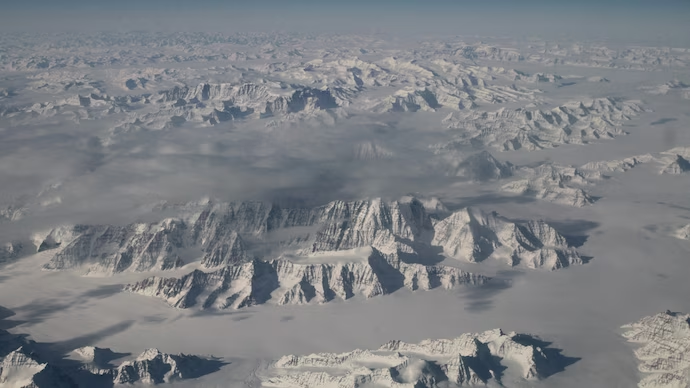
Source: NASA
Technological Advances Enable Accurate Ice Loss Measurements
CryoSat-2 and ICESat-2 use advanced altimeter technologies: radar for CryoSat-2 and laser systems for ICESat-2. Radar altimeters can penetrate cloud cover but require adjustments for ice surface penetration, while laser signals reflect directly off the surface but are blocked by clouds.
The complementary nature of these technologies improves the accuracy of ice thickness measurements. According to a study published in Geophysical Research Letters, data from both satellites align within 3%, confirming their combined use for precise ice loss estimations.
Also Read: Scientists Engineered Crops To Absorb More Carbon Dioxide, Boosting Growth Of Sugarcane And Sorghum
Alarming Thinning Rates and Volume Loss
The Greenland Ice Sheet thinned by an average of 1.2 meters between 2010 and 2023, with the ablation zone shrinking by an average of 6.4 meters. The highest thinning rates were observed at outlet glaciers Zachariae Isstrom and Jakobshavn Isbrae, with rates of 75 meters and 67 meters, respectively. The Greenland Ice Sheet is thinning at unprecedented rates, with extreme heat events in 2012 and 2019 significantly contributing, causing annual losses of nearly 400 cubic kilometers.
Over the 13-year period, the total volume lost was 2,347 cubic kilometers, equivalent to the volume of Lake Victoria.
Also Read: The Climate Cost Of Trump’s Tariffs
Significance for Climate Change and Policy
Lead author Nitin Ravinder from the UK Centre for Polar Observation and Modelling (CPOM) highlighted the study’s critical role in understanding and addressing global sea level rise. The findings stress the importance of accurately monitoring polar ice dynamics as environmental challenges intensify and provide valuable data to help policymakers prepare for the effects of climate change.
Also Read: Delhi’s Air Quality Remains Very Poor Amid Ongoing Cold Wave And Fog Conditions

0 Comments