
From the deepest oceans to scorching deserts, and from freezing polar ice to the vacuum of space, some creatures possess astonishing abilities: survival tricks honed over eons that make them appear superhuman. These are not myths. The animals with real-life superpowers we describe here have been studied, measured, and verified by scientists. Their unique traits challenge our understanding of biology and showcase the extraordinary versatility of life on Earth.
1. Super-Survivors: Enduring the Extreme: Meet the Tardigrade
One of the most celebrated animals with real-life superpowers is the humble Tardigrade (also known as the “water bear” or “moss piglet”). These microscopic invertebrates measure merely 0.3–0.5 mm when fully grown, yet exhibit virtually superhuman resilience. Tardigrades can tolerate extreme heat and cold, vacuum and radiation, total dehydration, atmospheric pressure extremes, and even the void of space.
In one remarkable feat, tardigrades were exposed to the vacuum and radiation of outer space, then rehydrated, revived, and continued normal life, a feat unmatched by any other multicellular animal.
This extraordinary durability makes tardigrades a model for astrobiology, climate-stress research, and studies of biological limits. Their cryptobiotic state, where metabolism virtually stops, is a biological “superpower” allowing them to outlast conditions that would kill almost any other known species.
Also Read: 8 Animals That Can Survive Fire And Even A Nuclear Blast
2. Regeneration Masters: When Losing a Limb Isn’t the End: The Axolotl
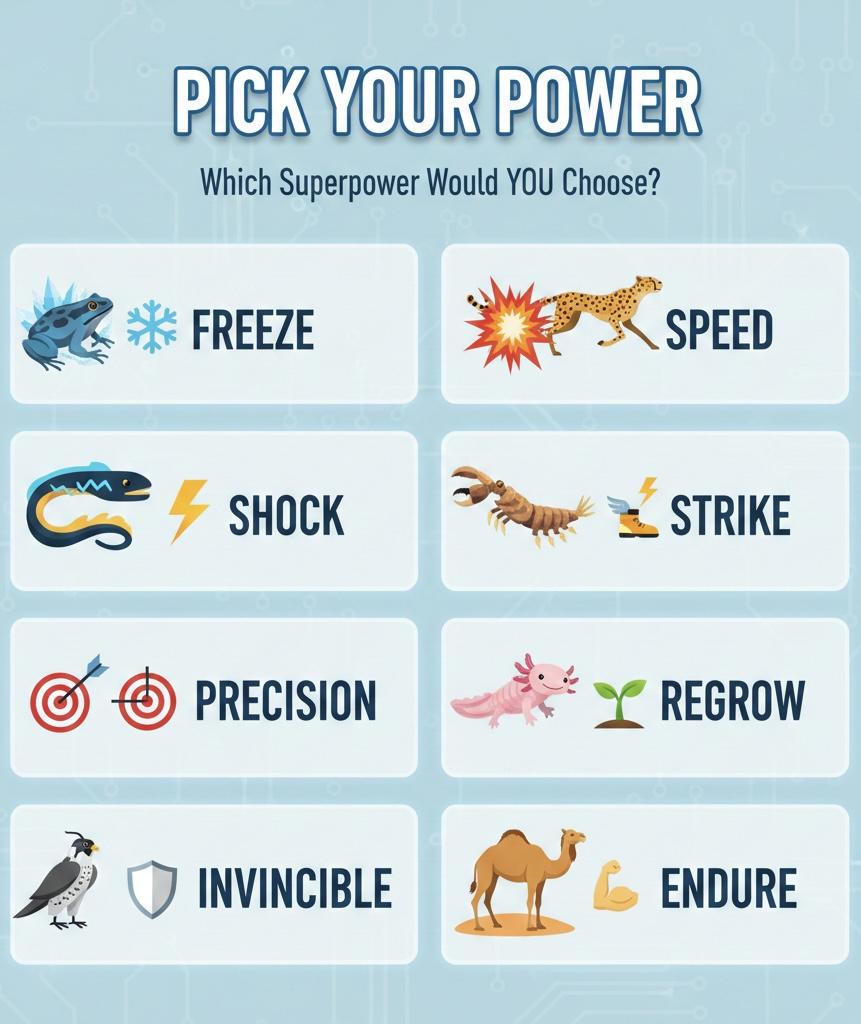
Some animals with real-life superpowers rebuild themselves from near-total damage. The Axolotl (Ambystoma mexicanum) is one such marvel. Unlike most vertebrates, this amphibian can regenerate entire limbs, parts of its spinal cord, and even sections of its brain without scarring.
Scientific research highlights that axolotls maintain populations of stem-like cells throughout their lives, enabling scar-free healing and full tissue regrowth. For medicine and regenerative biology, axolotls represent a living blueprint for what healing might one day look like in humans.
Also Read: Four-Decade Study Finds 788 Amphibian Species In Sharp Decline Globally
3. Speed, Precision & Lethal Strike: The Mantis Shrimp and Other Hunters
Among animals with real-life superpowers, some are equipped for offense just as nature intended. The Mantis Shrimp is a marine predator whose striking claws move with immense acceleration, delivering blows so fast and powerful they can shatter aquarium glass.
Moreover, mantis shrimp have among the most complex vision systems known: they detect polarized light, ultraviolet, and many more color wavelengths than humans, a visual superpower that gives them an edge in prey detection and communication.
Meanwhile, on land and in the air, other “superpowered” animals show equally remarkable abilities. The Cheetah, the fastest land animal, can accelerate from 0 to over 100 km/h in seconds, a sprint unmatched in the mammal world. The Peregrine Falcon achieves dive speeds over 320 km/h, making it the fastest member of the animal kingdom.
These adaptations, blistering speed, precision strikes, and extreme vision highlight how animals with real-life superpowers have evolved specialized tools for survival, hunting, defense, and competition.
Also Read: Biodiversity Boost: 13 New Bush Frog Species Found In Northeast India
4. Extreme Survival Tricks: Life in Deserts, Ice, and Beyond
Beyond regeneration and speed, many animals with real-life superpowers excel in surviving harsh environments. Some thrive in deserts, others in freezing cold, each with unique adaptations.
- The Camel, long known as the “ship of the desert,” survives scorching heat (over 49 °C), limited water for weeks, and sandstorms, a survival superpower in arid habitats.
- Animals like the Wood Frog can survive freezing winters by literally freezing solid and thawing later. They accumulate glucose to prevent ice-damage in cells during freezing, a survival mechanism akin to biological cryonics.
Such adaptations show how life’s superpowers are not always about strength or speed, but endurance, the ability to persist through extremes of heat, cold, dehydration, or oxygen scarcity.
Also Read: New Deep-Sea ‘Octopus Squid’ Species Discovered In Kerala Waters
Why Evolution Created These Superpowers: The Science Behind the Extremes
So why do these animals exist with such profound abilities? Evolution, natural selection, and ecological niches shaped by extreme pressures encouraged adaptations far beyond the ordinary.
For example, microscopic organisms like tardigrades evolved extraordinary resilience, likely as a survival mechanism in environments with fluctuating moisture, radiation, or oxygen levels.
Species like axolotl, with regenerative powers, possibly evolved in stable aquatic environments where predation or injury risk favored individuals that could heal rather than scar. The aquatic-to-terrestrial transition, predation, and competition may have driven the development of rapid movement, precision claws, or enhanced vision in species like mantis shrimp, cheetah, or peregrine falcon.
In deserts or polar zones, variable climates, scarce resources, or harsh winters demanded adaptations such as water-storage, metabolic slowdown, or freeze tolerance, resulting in the survival superpowers we observe today.
These aren’t magic traits; they are evolutionary investments, high-cost, high-reward features honed over millennia, proving that life’s ingenuity often outpaces human imagination.
Also Read: Mount Kilimanjaro Loses Nearly 75% Of Its Plant Species — Scientists Seek The Culprit
What These Superpowers Mean for Science, Conservation, and Human Insight
Studying animals with real-life superpowers offers more than wonder; it can inform breakthroughs in medicine, materials science, ecology, and climate resilience.
- Regeneration research with axolotl may one day inform human tissue repair, organ regeneration, and even spinal injury treatments.
- Tardigrade resilience gives clues about radiation resistance, dehydration tolerance, and survival in extreme environments, relevant for space travel, biotechnology, and understanding the limits of life.
- Mantis shrimp biomechanics inspire material science (shock absorption, underwater robotics), while their vision systems push boundaries of optical science.
- Understanding desert or cold-adapted animals helps conservationists predict how species might respond to climate change; animals with survival superpowers might be critical “refuges” of resilience.
- Finally, promoting awareness of such animals helps highlight biodiversity’s incredible breadth, reminding us that protection of habitat, species, and ecological balance preserves not just common fauna, but nature’s most extraordinary life-forms.

Also Read: Two Key Coral Species In Florida Declared Functionally Extinct After Devastating Ocean Heatwave
Conclusion: Nature’s Superheroes Are Real, and They Matter
From the nearly indestructible tardigrade to the regenerating axolotl, from high-speed predators to climate-defying survivors, the roster of animals with real-life superpowers is long, diverse, and truly awe-inspiring. These creatures show that life evolves not just for comfort, but often for survival at the edges, extremes where ordinary biology fails.
Studying them is more than fascination: it offers insight into biology’s limits, pathways to innovation, and a deeper respect for biodiversity. As humans face global change, habitat loss, and environmental stress, protecting these remarkable creatures and their habitats means preserving not just species, but biological superpowers refined by evolution.
Short Data Snapshot
| Trait / Superpower | Species Example | Measured Extreme / Fact |
|---|---|---|
| Extreme survival — radiation, vacuum, dehydration | Tardigrade | Survives vacuum, space, dehydration; revives on rehydration |
| Limb/organ regeneration | Axolotl | Can regrow limbs, spinal cord, and brain tissue |
| Hyper-fast strike + advanced vision | Mantis Shrimp | Strikes faster than the blink of an eye; an ultra-complex vision system |
| Top animal land/air speed | Cheetah (land), Peregrine Falcon (air) | Cheetah: ~104 km/h top ground speed; Peregrine Falcon dive > 320 km/h |
| Extreme climate-tolerance (heat, cold, drought) | Camel / Wood Frog / Desert & Arctic species | Camels: survive desert heat and thirst; Wood Frog: freeze solid in winter and revive |
Also Read: Top Animals Movies Of 2024-25 That Showcase The Wonders Of Wildlife
FAQs
1. Are these superpowers like in comics–permanent and guaranteed?
Not always. Many “powers” (like regeneration, survival adaptations) come with trade-offs — slower growth, specific habitat needs, limited endurance. Even animals like the tardigrade survive extremes only in special states (e.g., cryptobiosis), not active life.
2. Could humans ever “borrow” or mimic these powers (e.g., regeneration)?
Research inspired by animals like the axolotl or tardigrade is active in regenerative medicine, DNA repair, and stress-resilience studies. While direct “superpowers” for humans are unlikely soon, these animals provide biological clues that might inform future therapies.
3. Do these superpowered animals live long lives?
Not always. Some, like mantis shrimp or cheetahs, have normal lifespans, though they use their abilities for survival. Others, like tardigrades, survive extreme events but don’t necessarily live longer than typical in stable conditions.
4. Are superpowered animals more likely to go extinct?
Paradoxically, sometimes yes. Specialized adaptations often depend on precise habitats or ecological conditions. As environments degrade or change (climate change, pollution), these specialists may be more vulnerable than generalist species.
5. Should we prioritize conservation of such “superpowered” species over ordinary ones?
All species matter. While superpowered animals are extraordinary and scientifically significant, preserving ecosystem integrity means protecting biodiversity as a whole, so ecological balance, lesser-known species, and common habitats also need safeguarding.
Also Read: Can Wildlife Bridge Truly Make A Difference In Conserving Endangered Species?

0 Comments