
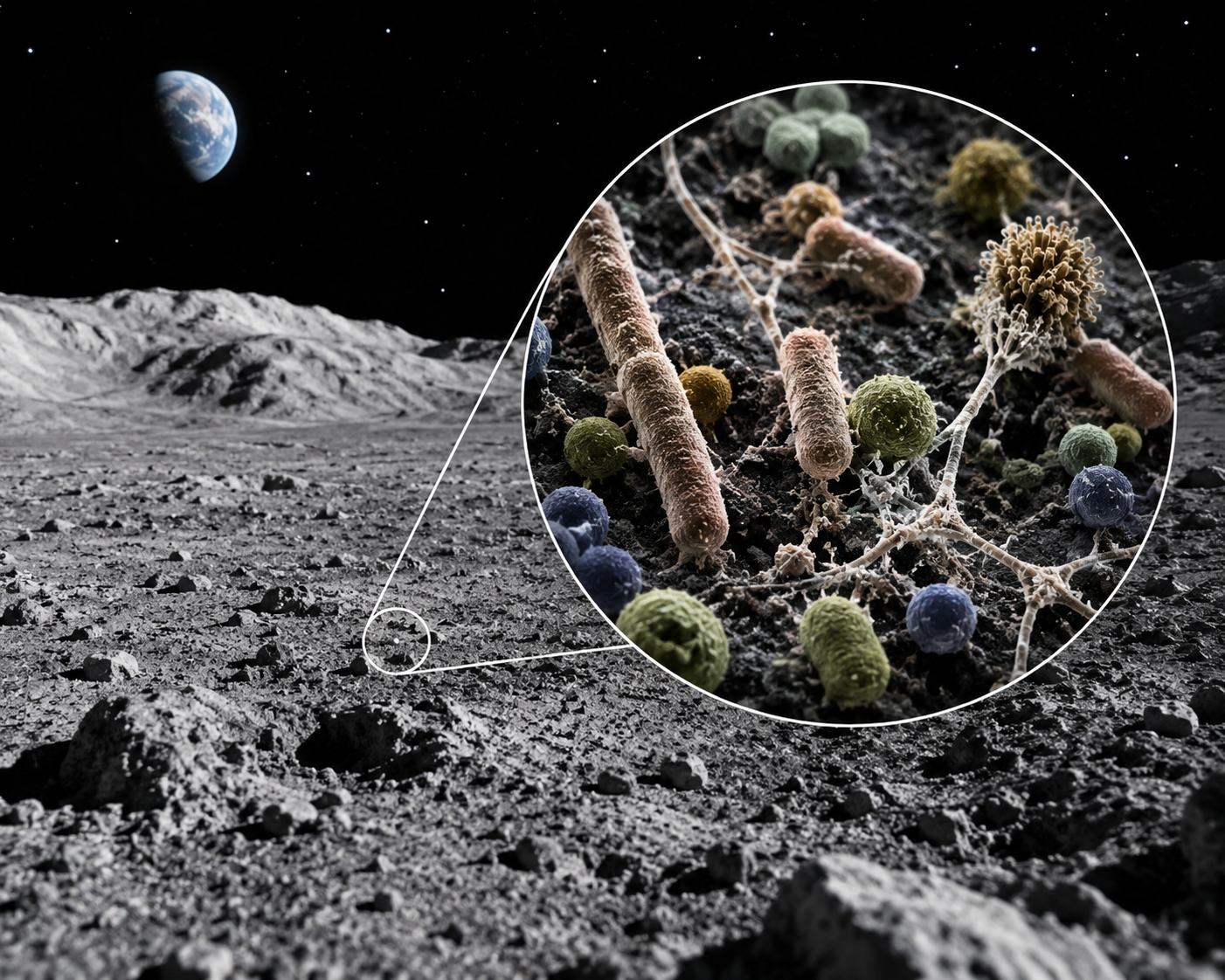
Human microbes could survive on the Moon’s South Pole, according to a NASA study published in Science Advances on August 19, 2026, raising new questions about contamination as astronauts establish a more permanent presence on the lunar surface. Researchers found that several microbes associated with humans and spacecraft environments could remain alive for at least one Earth day in some shaded areas around the Moon’s South Pole. The finding does not mean the organisms can grow or reproduce there, but it suggests that microbial contamination could persist long enough to complicate future scientific investigations.
The study focused on how five types of microbes might respond to conditions around three potential lunar South Pole exploration sites.
Why Human Microbes Matter on the Moon
Microbes are an unavoidable part of human spaceflight. Humans carry, on average, around 1 million bacteria on each patch of skin the size of a pencil eraser, and organisms can escape from spacesuits and habitats.
That creates a scientific challenge. As astronauts explore the Moon, researchers may encounter microorganisms or chemical traces introduced from Earth. Without knowing what humans have brought with them, it could become harder to distinguish ancient lunar chemistry from later contamination.
NASA scientists say the issue will become even more important when missions eventually travel to Mars in search of evidence of life.
Study detail |
Information |
|---|---|
Publication |
Science Advances |
Publication date |
August 19, 2026 |
Agency |
NASA |
Study region |
Moon’s South Pole |
Sites modelled |
Nobile Rim, Connecting Ridge, De Gerlache Rim |
Survival definition |
Alive for at least one Earth day |
Microbes studied |
Bacteria and fungi |
Key example |
Aspergillus niger |
Also Read: World Mosquito Day 2026: Why Dengue Awareness Matters More Than Ever
The Moon Has Unexpected Microbial Niches
The Moon’s poles have a distinctive lighting environment because the Moon has very little axial tilt. From the polar regions, the Sun appears close to the horizon.
Crater ridges, mountains and even small surface features can therefore block sunlight from reaching lower areas. These shaded pockets can remain extremely cold and may preserve water while shielding molecules and potential microorganisms from intense radiation.
Researchers used this geography to identify potential “survivable niches”, ranging from areas across crater floors to spaces as small as an astronaut’s boot print.
Also Read: Eco Homes Launch in England and Wales to Combat Heat Waves
Five Microbes Were Examined
The scientists focused on organisms commonly associated with human skin and spaceflight environments. These included:
- Aspergillus niger
- Bacillus subtilis
- Staphylococcus aureus
- Deinococcus radiodurans
- Several species of Fusarium
The team used information from previous studies about how much heat and ultraviolet radiation each organism can withstand.
They then modelled conditions at Nobile Rim, Connecting Ridge and De Gerlache Rim, using elevation and temperature information from NASA’s Lunar Reconnaissance Orbiter, along with models showing how radiation reaches the lunar surface.
Also Read: Swiss Lake Zurich Reaches Historic Low Amid Prolonged Drought
Aspergillus niger Shows Strongest Survival Potential
Among the organisms studied, Aspergillus niger showed the greatest resistance to ultraviolet radiation. The fungus was able to survive in some areas that receive sunlight exposure.
- The result is notable because A. niger is not normally classified as an extremophile.
- It is commonly found in warm, damp environments such as bathrooms and heating, ventilation and air-conditioning systems.
- Astronauts have also sampled the fungus inside the International Space Station, while experiments have demonstrated that it can survive outside the station.
NASA scientists had previously been surprised to find such microbes surviving on the exterior of the space station.
Also Read: First River Otter Spotted In Bronx River As Decades Of Conservation Pay Off
Survival Does Not Mean Growth
The researchers stress an important distinction: survival in the study means remaining alive for at least one Earth day. It does not demonstrate that the organisms could grow and reproduce on the Moon.
The authors also found no evidence that the Moon currently has the key ingredients needed for microbial growth and replication. One important requirement is liquid water, which typically requires an atmosphere and moderate temperatures.
The concern is therefore primarily about persistence and contamination, rather than the Moon becoming a habitat where Earth microbes can establish populations.
Also Read: Scientists Unite To Rebuild Florida’s Declining Coral Reefs In A Historic Collaboration
Lessons for Future Lunar and Mars Missions
As NASA’s Artemis-era exploration develops, the study suggests that human microbes could survive on the Moon’s South Pole and microbial contamination will need to remain part of lunar planning. The same knowledge could become even more important for Mars missions, where identifying possible signs of life will require researchers to know whether biological material is truly extraterrestrial or originated with human explorers.
Also Read: Florida Officials Confirm No Criminal Activity in Sloth Deaths at Attraction

0 Comments