
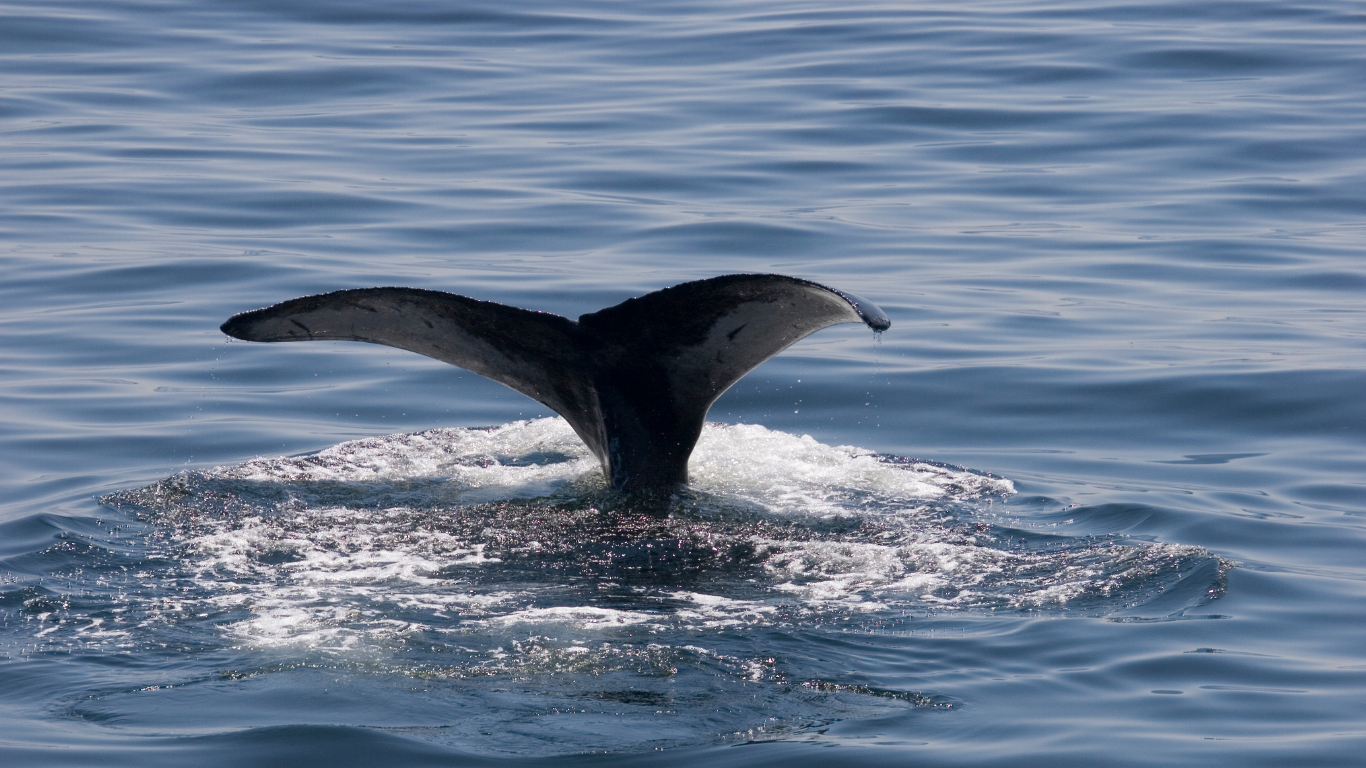
Giant whales enter Greenland waters as Arctic sea ice declines, revealing a striking ecological change along the East Greenland coast. A decades-long study has documented hundreds of humpback, fin and minke whales feeding in coastal waters that were historically blocked by sea ice. In the summer of 2024 alone, researchers estimated that around 4,000 humpback, 6,000 fin and 6,000 minke whales entered the Greenland Sea, consuming at least 800,000 tonnes of fish and krill during the feeding season.
The findings point to more than a temporary increase in whale sightings. Scientists describe the change as a major ecological regime shift linked to warming seas, retreating ice and changing prey distribution.
From Ice-Bound Waters to Whale Feeding Grounds
East Greenland’s coastal waters were historically difficult for large baleen whales to access because extensive sea ice kept them out for much of the year. As Arctic temperatures have risen and summer ice has retreated, that physical barrier has weakened.
The change became particularly noticeable in whale surveys. Researchers recorded no humpback sightings during ship-based surveys before 2006. One year later, seven were recorded. By 2024, 150 humpback sightings had been documented during ship-based observations.
Finding |
2024 Estimate/Observation |
|---|---|
Humpback whales |
~4,000 |
Fin whales |
~6,000 |
Minke whales |
~6,000 |
Estimated fish and krill consumed |
≥800,000 tonnes |
Humpback ship sightings |
150 |
Systematic aerial surveys |
2015 and 2024 |
Also Read: Scientists Unite To Rebuild Florida’s Declining Coral Reefs In A Historic Collaboration
Decades of Observations Reveal the Shift
The researchers combined several sources of evidence to understand how quickly the ecosystem was changing.
- Systematic aerial surveys of baleen whales were conducted during the summers of 2015 and 2024, while satellite tracking followed 15 tagged whales.
- Researchers also incorporated observations and knowledge from Inuit hunters, providing information that extended beyond formal scientific surveys.
Together, the evidence showed that whales were not simply passing through the region. They were using the newly accessible waters as seasonal feeding grounds.
Also Read: First River Otter Spotted In Bronx River As Decades Of Conservation Pay Off
Why Are the Whales Moving North?
Food appears to be a major factor.
As the waters around East Greenland warm, fish and other prey species are moving into areas that previously offered limited access to large baleen whales. The whales are following that food supply.
During the summer feeding period, humpback, fin and minke whales can consume enormous quantities of fish and krill. Researchers estimated that the three species together could consume at least 800,000 tonnes during a summer season.
This creates what scientists describe as seasonal Arctic “feeding frenzies”, with large numbers of whales concentrating in productive, ice-free waters.
Also Read: Swiss Lake Zurich Reaches Historic Low Amid Prolonged Drought
A Bigger Change Than More Whale Sightings
As giant whales enter Greenland waters, they could alter relationships between predators, prey and fisheries in the region. It also demonstrates how quickly marine ecosystems can respond when sea-ice conditions change.
For the whales, the newly accessible habitat represents an opportunity to exploit food resources that were previously difficult or impossible to reach. For scientists, however, the change provides another example of how warming is reorganising Arctic ecosystems.
The long-term consequences remain uncertain. If sea ice continues to retreat, East Greenland could become an increasingly important seasonal feeding area for large baleen whales. At the same time, changes in prey distribution, fisheries and ocean conditions could reshape the ecosystem again.
Also Read: Florida Officials Confirm No Criminal Activity in Sloth Deaths at Attraction

0 Comments