
Africa is experiencing an unparalleled climate crisis, with the most catastrophic five-year period in terms of the number of people killed by weather-, climate-, and water-related disasters occurring between 2021 and 2025. Based on a study of the Emergency Events Database (EM-DAT), Down to Earth (DTE) found that 28,759 individuals died and over 221.57 million people were affected during this period, marking Africa’s deadliest climate crisis in over a decade.
What is the Extent of Africa’s Deadliest Climate Crisis From 2021 to 2025?
The scope of Africa’s climate problem between 2021 and 2025 was astounding. At least 221.57 million persons were impacted, according to DTE’s analysis of EM-DAT data, which is more than the combined totals from 2011–2015 (99.36 million) and 2016–2020 (91.15 million). Twenty-eight thousand seven hundred fifty-nine people died as a result of disasters, more than tripling the 8,106 deaths that occurred between 2016 and 2020. Given the severity of the crisis, these numbers, which are based on data through May 2025, are likely to increase further by the end of the year.
Droughts, floods, cyclones, landslides, cold waves, and heat waves were among the extreme weather events that affected the continent, accounting for 54% of the 412 million people affected by catastrophes since 2011.
Comparison of Disaster Impacts Across Periods
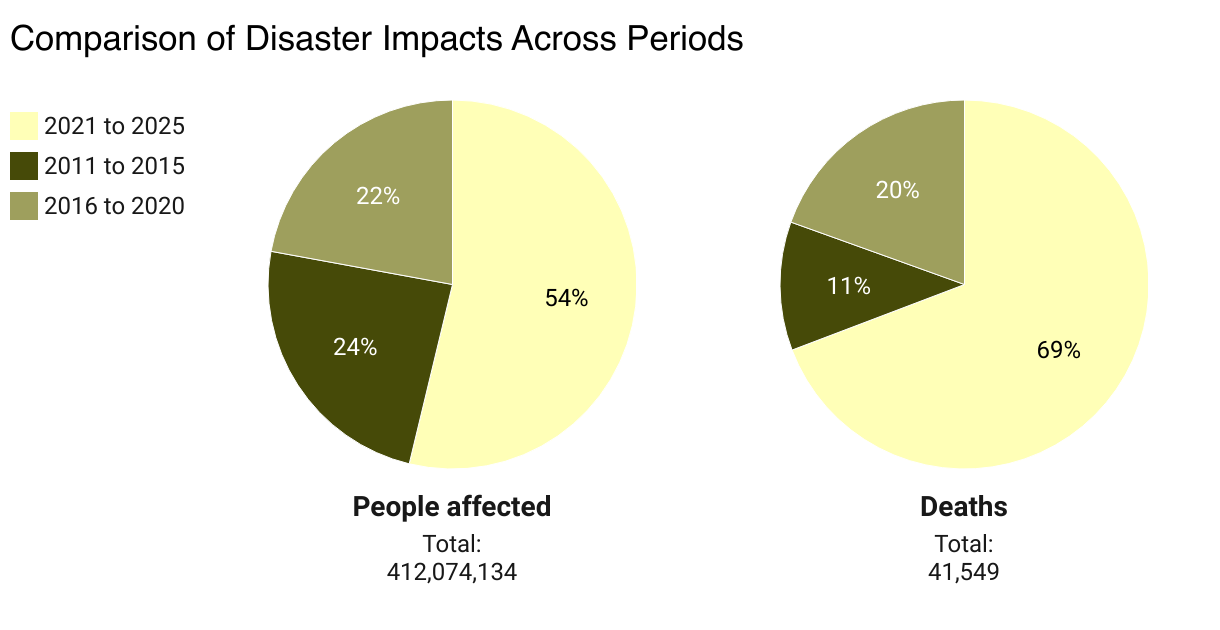
| Period | People Affected (millions) | Deaths |
|---|---|---|
| 2011–2015 | 99.36 | 4,684 |
| 2016–2020 | 91.15 | 8,106 |
| 2021–2025 | 221.57 | 28,759 |
Also Read: Exploring Africa’s Endangered Wildlife: A Look At The Climate Threats Facing Animals In Africa
Which Natural Disasters Have Had the Most Significant Impact?
Approximately 178 million people, or more than 81% of those affected between 2021 and 2025, have been impacted by droughts, making them the most severe hazard. Approximately 14% of the population was harmed by flooding, while storms or cyclones affected 4.7%. This distribution highlights how droughts predominate.
According to the UN, the Horn of Africa, specifically Ethiopia, Somalia, and Kenya, experienced five consecutive unsuccessful rainy seasons, culminating in the worst drought in 70 years by January 2023. In 2024, a powerful El Niño event made the catastrophic droughts in Southern Africa and the Zambezi basin much worse.
Also Read: India–Africa Agricultural Partnership: Strengthening Food Security Amid Global Challenges
How Have Specific Countries Been Affected?
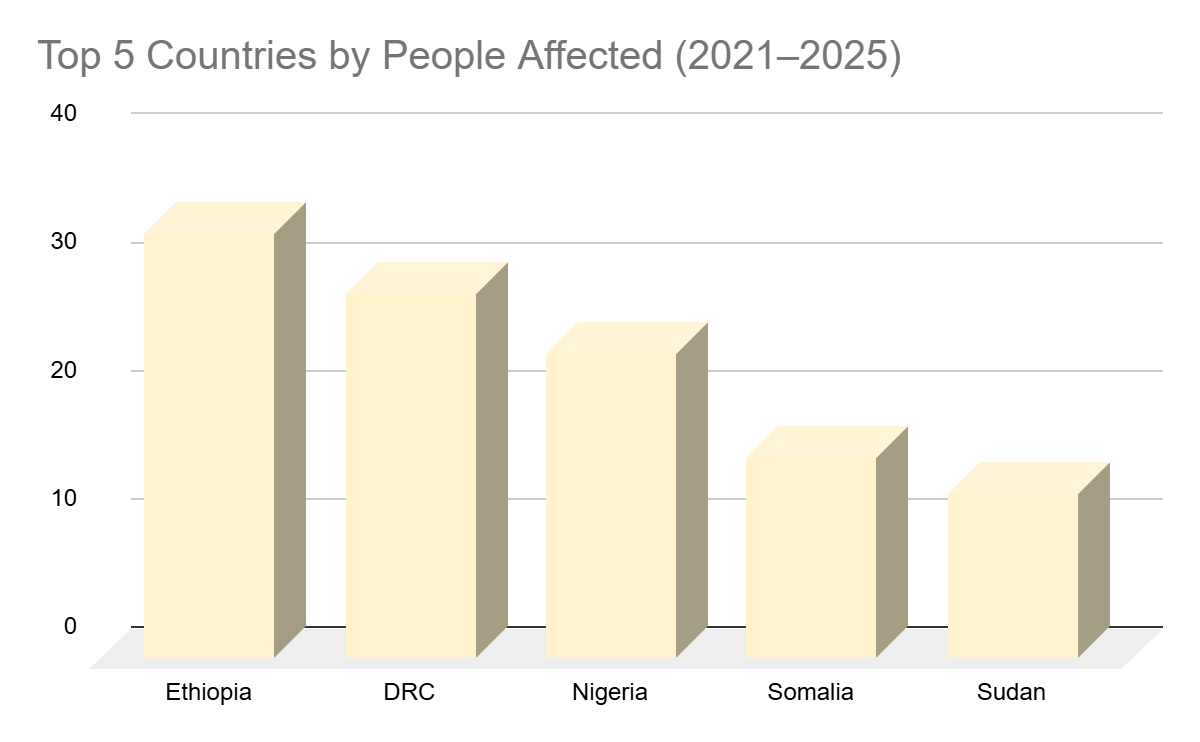
Some countries have been disproportionately affected by the issue; more than 51% of all affected persons live in five countries.
- With 33.1 million impacted, Ethiopia experienced the most significant impact, a 17-fold rise over the preceding five years.
- With 28.5 million impacted, the Democratic Republic of the Congo (DRC) came next, a 42-fold increase.
- 23.7 million people were reported to be impacted in Nigeria,
- 15.6 million in Somalia, and
- 12.8 million in Sudan.
North Africa had the highest fatality rate, with Libya accounting for 13,205 deaths, mainly from the devastating Derna floods on September 10, 2023.
Top 5 Countries by People Affected (2021–2025)

| Country | People Affected (millions) | Increase from 2016 to 2020 |
|---|---|---|
| Ethiopia | 33.1 | 17-fold |
| DRC | 28.5 | 42-fold |
| Nigeria | 23.7 | 10-fold |
| Somalia | 15.6 | 3.65 times |
| Sudan | 12.8 | 8-fold |
Also Read: Climate Change Poses Severe Threat To Global Crop Yields
What Are the Leading Causes Behind the Increase in Disaster-Related Deaths?
The dramatic increase in deaths from disasters, from 4,684 in 2011–2015 to 28,759 in 2021–2025, is a result of both institutional shortcomings in disaster preparedness and the growing severity of climate-related occurrences.
46% of deaths during this time were caused by the Derna floods in Libya alone, highlighting the fatal consequences of poor infrastructure.
Flooding was a significant factor in the DRC’s seven-fold spike in mortality and Malawi’s 16-fold increase. According to the World Meteorological Organization (WMO), climate change has increased the likelihood of catastrophes, such as the Horn of Africa drought, by at least 100 times, exacerbating vulnerabilities.
Also Read: Deadly Rice Virus Threatens Africa’s Food Security
What Measures Are Being Taken Or Should Be Taken to Mitigate These Effects?
Urgent action is needed to address Africa’s deadliest climate crisis. The WMO’s State of the Climate in Africa 2024 assessment emphasizes the necessity for improved early warning systems and climate adaptation plans. Launched in September 2023, the Early Warnings for All Action Plan for Africa aims to ensure that vulnerable populations receive timely and accurate alerts.
However, the cost of adaptation in sub-Saharan Africa is projected to be $30–50 billion per year over the next decade, amounting to 2–3% of the region’s GDP. At the same time, recovery efforts are threatened by a projected 42% drop in U.S. humanitarian aid in 2025.
While international aid is critical, African governments must also invest in disaster response, risk reduction, and climate resilience to prevent worsening of Africa’s deadliest climate crisis.
Also Read: Arctic Sea Ice Day: Spotlight On Melting Ice Caps And Glaciers Amid Climate Crisis
FAQ
1. What is the EM-DAT database?
The Centre for Research on the Epidemiology of Disasters (CRED) maintains EM-DAT, which includes records on over 26,000 global disasters since 1900. It supports humanitarian efforts and policy planning.
2. How does climate change contribute to these disasters?
By altering precipitation and temperature patterns, climate change intensifies extreme events. According to the WMO, it increased the likelihood of the Horn of Africa drought by a factor of 100.
3. What can individuals do to help?
Support climate legislation, contribute to organizations like the World Food Programme, and raise awareness about Africa’s deadliest climate crisis.
4. Why is Africa disproportionately affected?
Africa emits less than 4% of the world’s greenhouse gases, but suffers disproportionately due to its low adaptive capacity, poor infrastructure, and high vulnerability, according to the ND-GAIN Index.
Also Read: Climate Change Threatens 90% Of Wild Vanilla’s Pollination Links By 2050, Study Finds

0 Comments