
On July 19, 2025, Zelestra India’s 435 MW Gorbea Solar Power Project in Nokha, Bikaner District, Rajasthan, was officially inaugurated by Union Minister for New and Renewable Energy, Pralhad Joshi. Rajasthan’s 435 MW solar plant built in 8 months in a cutting-edge 1,250-acre facility, has the potential to revolutionize India’s renewable energy sector. The project will produce 755 gigawatt-hours of clean electricity annually, powering 128,000 families and lowering 705,000 tons of CO₂ emissions annually, according to a 25-year power purchase deal with the Solar Energy Corporation of India.
Rajasthan’s 435 MW solar plant built in 8 months was praised by Joshi as a “world-class facility” and said it was evidence of India’s dedication to sustainability, pointing out that renewable energy now accounts for 70% of Rajasthan’s electricity capacity, including 5.2 GW from wind and 29.5 GW from solar. This article examines the project’s importance, technological advancements, and contribution to India’s clean energy objectives.
What Makes the Gorbea Solar Project a Model of Speed and Efficiency?
Union Minister Joshi called the Gorbea Solar Power Project’s completion in an astounding eight months a “shining example of visionary leadership and sincere intent.” It utilizes cutting-edge Topcon Bifacial Mono PERC solar panels, which collect sunlight from both sides to maximize energy output, and spans 1,250 acres. In Rajasthan’s arid climate, more than 1,300 robotic cleaning units ensure that the panels remain dust-free and operate at their optimal performance.
Rapid execution was demonstrated by the construction of the project’s supporting infrastructure, which included a substation and a 6.5 km transmission line, in just five months. This efficiency sets a standard for upcoming renewable energy projects throughout India. It is the result of efficient project management, cutting-edge technology, and cooperation between Zelestra India and regional partners.
Also Read: IRENA: Global Renewable Energy Growth Remains Uneven Despite 15% Rise
How Does the Project Benefit Local Communities and Farmers?
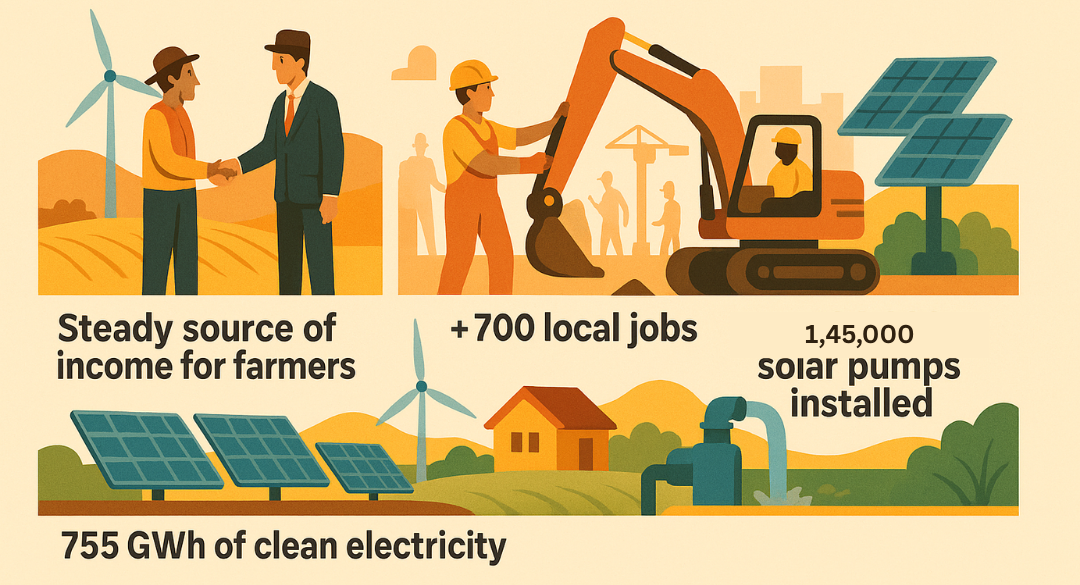
Local economies are significantly impacted by the Gorbea project, as it provides farmers with a steady source of income through the lease of their property. More than 700 local individuals were hired during the construction phase, promoting economic growth and skill development. It improves energy access in rural areas by providing 755 GWh of clean electricity per year to 128,000 families.
Furthermore, 145,000 solar pumps have been installed as a result of Rajasthan’s implementation of the PM-KUSUM scheme, providing farmers with access to reasonably priced, renewable energy for irrigation and reducing their dependency on fossil fuels. Although 270,000 applications are still pending, the Pradhan Mantri Surya Ghar scheme has also facilitated 49,000 rooftop solar installations, with subsidies totaling over ₹325 crore, underscoring the high demand in the community. These programs enhance local resilience and empower farmers.
Also Read: How Energy Instability Shapes Economic And Environmental Policy
Why Is the Gorbea Project Critical for India’s Climate Goals?
Rajasthan’s 435 MW solar plant built in 8 months is a significant step toward India’s climate obligations, reducing 705,000 tonnes of CO₂ emissions yearly. Five years ahead of the 2030 target, Joshi pointed out that India has reached 50% of its installed power capacity from non-fossil sources, with Rajasthan contributing 35.4 GW, which includes 5.2 GW from wind and 29.5 GW from solar. The state’s Green Hydrogen Policy and Integrated Clean Energy Policy 2024 have drawn ₹6.57 lakh crore in investment proposals, primarily for green hydrogen and renewable energy.
Long-term sustainability is ensured by the project’s high-efficiency panels and innovative maintenance techniques, which complement international efforts to address climate change. Joshi also emphasized how perovskite tandem solar cells, which are presently being studied at IIT Bombay, could be used to increase energy yields in areas with high levels of radiation, such as Rajasthan.
Also Read: India Needs $1.5 Trillion By 2030 For Climate And Energy Targets: Deloitte
What Future Opportunities Does Rajasthan Hold for Renewable Energy?
Joshi, who promoted wind-solar hybrid projects to optimize resource usage, pointed out that Rajasthan still has a large amount of untapped wind energy (284 GW). The state is positioned as a global hub for clean energy due to its aggressive measures, such as the Green Hydrogen Policy and the Integrated Clean Energy Policy 2024. Zelestra India intends to increase its renewable portfolio with the support of EQT and a 5.4 GW pipeline in India. Next-generation perovskite tandem solar cells, which promise greater efficiency than traditional modules, should be investigated for experimental projects, Joshi advised Zelestra and Rajasthan officials. Rajasthan’s leadership in solar, wind, and green hydrogen, which accounts for 70% of its power capacity, offers an example for sustainability and energy independence in India.
| Gorbea Solar Power Project Impact | |
| Metric | Details |
| Capacity | 435 MW |
| Location | Nokha, Bikaner, Rajasthan |
| Area | 1,250 acres (505.8571 hectares) |
| Electricity Output | 755 GWh annually, powering 128,000 households |
| CO₂ Emissions Reduction | 705,000 tonnes annually |
| Technology | Topcon Bifacial Mono PERC panels, 1,300+ robotic cleaning units |
| Construction Time | 8 months, including 5 months for the substation and transmission line |
| Policy Support | Integrated Clean Energy Policy 2024, Green Hydrogen Policy, PM-KUSUM, PM Surya Ghar |
| Economic Impact | 700+ local jobs, farmer land leases, ₹6.57 lakh crore in renewable investments |
Also Read: Latest Solar Panel And Energy Advancements Across US
Frequently Asked Questions (FAQs)
Q1. How does the Gorbea Solar Project contribute to environmental sustainability?
Rajasthan’s carbon footprint is significantly reduced by the project, which produces 755 GWh of clean electricity annually and reduces 705,000 tonnes of CO₂ emissions, equivalent to the amount needed to power 128,000 houses with renewable energy.
Q2. What technologies enhance the efficiency of the Gorbea Solar Project?
It uses more than 1,300 robotic cleaning units and Topcon Bifacial Mono PERC solar panels, which collect sunlight from both sides, to keep the panels operating efficiently in Rajasthan’s dusty climate.
Q3. How do national schemes like PM-KUSUM and PM Surya Ghar support Rajasthan’s growth in renewable energy?
Farmers now have access to 145,000 solar pumps thanks to PM-KUSUM, and PM Surya Ghar has subsidized 49,000 rooftop solar installations with ₹325 crore. However, 270,000 applications are still pending, indicating strong demand.
Also Read: Innovations In Solar Turbines For Enhanced Efficiency And Renewable Energy Generation

0 Comments