
A new study revealed that more than 8000 illegal waste sites are identified across the UK, which caused a loud noise among the communities, environmental groups, and taxpayers. The scale of the waste piled up in illegal dumps is unbelievable, and the effects on public health, the environment, and government coffers will be very severe and will last a long time. In this article, I explain to you what this discovery means, why it is a disaster, what is being done (or not), and why it should matter to you.

The Big Picture: Scope of the Problem
- The study findings reveal that there are at least 8000 illegal waste sites identified across the UK.
- Illegal dumps are said to be holding approximately 13 million tonnes of rubbish.
- Since the waste is disposed of without any permits or oversight, the criminals who operate on the black market do not pay the standard landfill tax. That is an estimated £1.63 billion in unpaid tax, money that would have been used for proper waste management.
- The real figure could be far beyond that: some experts are saying that, according to some estimates, the total number of illegal waste sites might be as high as 13,000.
So the bottom line is that 8000 illegal waste sites identified across the UK are probably only the minimum number of sites. The actual volume of illegally dumped waste might be way beyond that.
Also Read: Why Did UK Plastic Waste Exports To Developing Countries Rise By 84%?
Why It Matters — Risks & Consequences
Illegal waste sites are not only ugly heaps of garbage, but they also have a variety of risks, including environmental, health, social, and economic. Here’s a breakdown:
Environmental & Health Risks
- Without regulation for waste, there is nothing to prevent polluting substances from entering the soil, rivers, or underground water, and they are particularly dangerous with toxic or hazardous waste.
- There are reports that some of these places have caught on fire, thus destroying the quality of the air in the local area and endangering the people living close by.
- Continuous dumping of common garbage, construction waste, and sometimes industrial waste in an area causes the land around to be degraded, the ecosystems to be destroyed, and, in general, the creation of “eyesores,” litter, smells, and community blight.
Economic & Social Costs
- The £1.63 billion landfill tax that is lost not only means that the government has less money to spend, but it also weakens the legitimate waste‑management services.
- The moment the places where dumping occurs are found, the costs of cleaning, restoration, and legal procedures are very high for the taxpayers. For example, the case of Hoad’s Wood is one of them, where about £15 million was spent to clear around 35,000 tonnes of rubbish that had been dumped.
- Those who live near these dumps, the burden will be on them: from health risks to a degraded environment to social stigma, especially if the waste is toxic.
Also Read: How Europe Is Battling E-Waste And What It Means For The US
What’s Going On Behind the Scenes
It is not a matter of badly kept homes – organized criminals run many of these sites or are out to make a fast buck by illegal waste management operators, who treat waste disposal as a lucrative business.
Experts say:
- Illegal dumping is a low-risk, high-reward venture due to weak oversight and enforcement.
- Besides that, the very means that are to be used for waste disposal, such as permits, monitoring, and landfilling regulations, are being bypassed.
- It is true that the authorities have closed a fair number of illegal waste sites; however, they are far from being able to keep up with the speed of the problem on the ground. For instance, the regulator Environment Agency (EA) closed 743 illegal waste sites in 2024–2025 alone.
- At the same time, the majority of incidents are still going on, some for more than ten years.
One very interesting thing uncovered by the research is that despite the fact that Air & Space Evidence, a cutting-edge satellite-imaging company, offered its technology to locate illegal dumps as a method that was tried and proven successful in other countries, the EA apparently didn’t want to hear about it at the management level. Critics argue that this is a sign of “institutional inertia” – maybe because finding more sites means that there will be more work to do for cleaning them.
As an expert quoted in the study put it: “The Environment Agency would rather not know, as if they do find more illegal waste sites, then they feel they will have to do something about them.”
Also Read: Inside The Pacific Ocean Garbage Patch: The Floating Continent Of Plastic Nobody Talks About
What Has Been Done, and What Needs to Be Done
Here’s a quick overview of proposals and actions:
| Measure/Action | What’s happening now / Proposed change |
|---|---|
| Enforcement and Clean Up | 743 illegal waste sites closed by the Environment Agency (EA) in 2024-2025 |
| Ongoing Investigations | Over 1,140 cases remain open, some lasting for years. |
| Intelligence & Detection Tools | Air & Space Evidence’s satellite‑based detection tool, which has been successful abroad, remains underused by EA. |
| Inter-Agency Coordination | Coordination between the EA, the police, and the customs agencies for the illegal export of waste and the national waste crime units |
| Public Reporting & Awareness | Encourages residents, landowners, and farmers to use the hotlines and whistle-blowing system to report illegal dumps |
Also Read: Lakshadweep Buried Under 4000 Tonnes Of Waste, Threatening Reefs And Livelihoods
Why This Should Matter to You (Even Outside the UK)
Lessons learned from the UK data and cases are applicable to the entire world. Due to illegal dumping, weak regulation, and lax enforcement, such situations can occur (and do occur) in any place.
- Environmental chain reaction: When pollutants seep into soil or water, they can degrade nature, animals, and even humans through food chains.
- Public health risk: Along with fires, toxic substances, airborne pollution, and contaminated water, all other problems are interconnected.
- Economic burden on society: The expenses for cleaning up, court proceedings, and stolen tax revenues are, in the end, money that the public has to pay in one way or another.
- Moral accountability & civic duty: Waste never goes away — it only moves. Thus, giving waste the proper disposal it deserves and enforcing it are two necessary conditions for sustainable societies.
Without more governments tackling the problem of illegal dumping, we will experience consequences such as the increase of “rubbish mountains,” of contaminated land, of health hazards and economic losses, as well as the decline of trust in regulatory institutions.
Also Read: Garbage Management Cuts Pollution By 26% In Key Areas: IIT Delhi
What You Can Do (Yes – Even as an Individual)
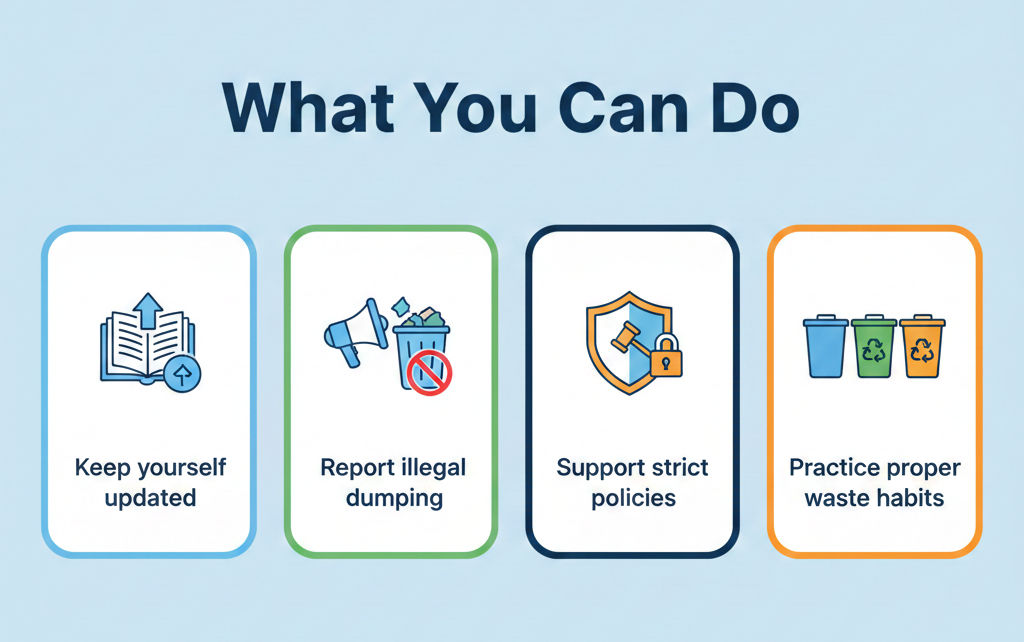
- Keep yourself updated and help others to do the same. Help by sharing articles, reports, and teaching others about the hidden cost of illegal waste dumping.
- Illegal dumping can also be reported. Are there any situations of unlawful dumping that you have noticed (for example, the turning of fields into rubbish sites)? Report these incidents to the local environmental agencies or hotlines.
- Support the implementation of fair and strict policies that ensure transparent monitoring and diligent law enforcement.
- Practice the proper waste habits. Follow the 3Rs: reduce, reuse, recycle, and be sure that licensed, legitimate service providers dispose of waste.
Also Read: Ubiquitous And Untenable: The Global Plastic Pollution Challenge
Conclusion
The discovery that there are more than 8000 illegal waste sites identified across the UK is not only a bad piece of information. It is also an alarm sign loud and clear – for governments, regulators, communities, and citizens alike.
If you care about a cleaner planet and about justice for communities living near these dumps, then turning on the spotlight on illegal waste dumping is the only way. Because rubbish doesn’t disappear by itself. It needs accountability, enforcement, and people willing to protect the future.
FAQs
Q1: What exactly is meant by “illegal waste sites”?
Illegal waste sites are those areas where waste has been dumped, stored, or disposed of without the necessary permits according to environmental regulations.
Q2: Why don’t authorities simply clean up all such sites immediately?
Firstly, many such places remain unknown or unreported. After that, the processes take a lot of money, which most of the time is the taxpayers’ money. Additionally, even the agencies that regulate find it more convenient to ignore all illegal sites than to acknowledge their existence.
Q3: Can this problem happen in other countries too, not just the UK?
Of course. Any country that suffers from weak enforcement, poor regulation, or a lack of public awareness will experience illegal dumping. The UK’s case is a wake-up call.
Also Read: Climate Change Is Rapidly Accelerating The Spread Of Dangerous Microplastics

0 Comments