
Lake-effect snow has long been a defining feature of winters in regions downwind of large bodies of water, especially the Great Lakes, but changing climate and shifting weather patterns raise a challenging question: Is lake-effect snow disappearing? Many climatologists and hydrologists warn that over the coming decades, this unique snowfall phenomenon could weaken or even vanish in certain areas. Below, we explore the science, evidence, and projections behind this possible transformation.
What Is Lake-Effect Snow — and Why It Happens
Lake-effect snow occurs when a mass of cold, dry air moves over relatively warmer, unfrozen lake water. The lake’s warmth evaporates moisture, which then rises, cools, condenses, and falls as heavy, localized snow bands downwind of the lake.
This mechanism has historically created some of the heaviest winter snowfalls in the United States. For instance, downwind of the Great Lakes, especially regions in western New York, northern Ohio, Michigan’s Upper Peninsula, and the Tug Hill plateau,regular lake-effect snow has given cities like Buffalo or Syracuse (NY) some of their highest seasonal totals.
However, lake-effect snow depends critically on a contrast between cold air and warmer water, as well as open, unfrozen lake surfaces during early winter. When those conditions shift, the snow-producing mechanism falters.
Warmer Lakes, Shorter Winters — The Changing Foundation

One of the clearest signals of change comes from the lakes themselves. According to research from the U.S. government’s Great Lakes monitoring, the historic winter ice cover has been shrinking rapidly. Since 1973, basin-wide ice cover across the Great Lakes has dropped by roughly 25%.
More recently, satellite-era data show that winter seasons over the lakes are getting shorter. A report from early 2025 states that winters are on average about two weeks shorter per decade since the 1995–1996 winter season.
What does this mean for lake-effect snow? Shorter winters, and thus delayed or absent ice formation, can prolong the period of open water over which cold air can pass, but also mean that by the time enough cold air arrives, lake waters may already have cooled or other conditions may not support significant evaporation. In essence, the window of ideal lake-effect snow conditions is narrowing.
Also Read: Heatwaves Drove A 9% Surge In India’s Power Demand In 2024, New Study Finds
Conflicting Trends: Short-Term Spikes vs Long-Term Decline
Interestingly, data over the last century show a mixed picture. In some lake-effect zones, sediment-based climate reconstructions, such as oxygen-isotope analyses from Finger Lakes (NY), indicate a significant increase in lake-effect snowfall during much of the 20th century, correlating with warmer lake surface waters and less ice cover.
Likewise, some modern studies argue that in a warming world, enhanced evaporation from warmer lakes may actually feed more moisture into the atmosphere and produce heavier snow events, at least in the near term.
But these gains may be deceptive and temporary. As global warming continues, air temperatures rise, even in winter, meaning that the cold air masses needed to trigger snow are less frequent. And once certain thresholds are crossed (warmer winters, shorter freezing seasons), precipitation may fall as rain instead of snow. The same warming that boosts evaporation may eventually prevent snow from forming.
Thus, while lake-effect snow hasn’t disappeared yet and may even see occasional spikes, the long-term outlook points to more rain, less snow, shorter snow seasons, and declining snowband frequency.
Also Read: How Do Insects Survive The Winter?
What Climate Projections Say — Gradual Fade of Snowbelts

Recent climate-model-based research into mid-latitude lake regions warns that as global temperatures climb, many lake-effect snow zones will shift. One 2024 study using future climate scenarios found that evaporation from lakes will increase, but warming air will often prevent snow formation, favoring rain or mixed precipitation, particularly in lower-latitude or marginal snow-belt zones.
Meanwhile, analysis of snowfall trends in the Northern Hemisphere shows a broader pattern: while some regions have maintained or even increased snow cover at certain times, overall snow-covered spring days declined between 1967 and 2023.
In practical terms, this means that many communities that depended on consistent winter snow for transportation, ecosystems, water supply, recreation, or seasonal rhythms may gradually lose the winter snow reliability they once had.
Also Read: Arctic Winter Sea Ice Reached Record Low In 2025, NASA And NSIDC Report
What Losing Lake-Effect Snow Means for Communities & Ecosystems
The decline of lake-effect snow extends beyond winters getting milder. The impacts can range from infrastructure and water supply to ecology and cultural change:
- Hydrology & Water Supply: Snowpack and meltwater contribute to lake recharge and groundwater. Less snow → altered runoff timing, potential water stress in spring.
- Ecosystems: Some flora and fauna are adapted to snow cover. Reduced snow can shift ecosystem dynamics, affect animals dependent on deep snow insulation, or change forest floor freeze-thaw regimes.
- Economy & Recreation: Winter tourism, ice-fishing, snow-based recreation, and local winter businesses (snow plowing, winter gear) all may suffer if snow becomes unreliable.
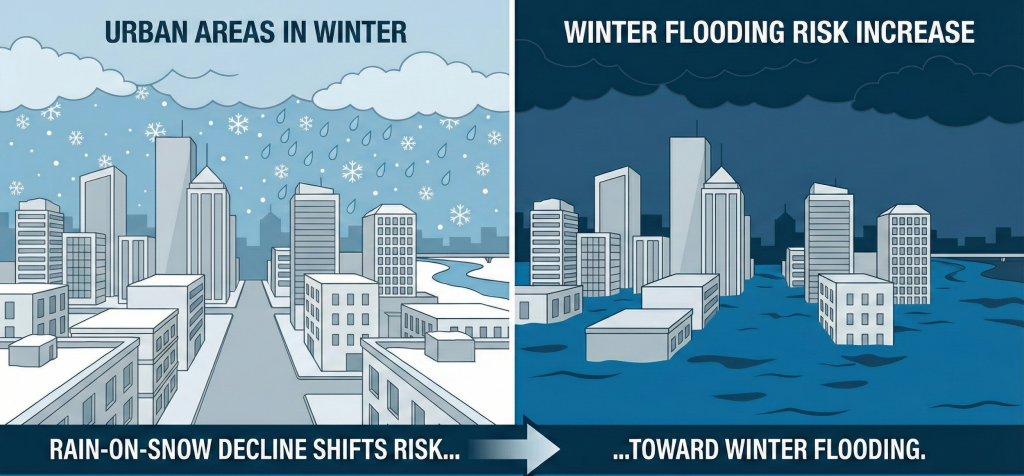
- Weather extremes: Warmer winters may reduce heavy snow risk, but also increase risk of winter rain, ice storms, or mid-winter flooding, a different form of hazard.
- Cultural identity: Regions known for snowbelts may lose part of their seasonal identity, traditions, and winter lifestyle.
Also Read: Russia’s Winter Temperatures Have Increased By 3°C Over 50 Years, Climate Expert Reveals
Conclusion: Lake-Effect Snow Is Not Gone Yet, But Its Future Is Fragile
Lake-effect snow remains a potent force in Great Lakes winters for now. But the underlying conditions that sustain it, sufficiently cold air, open yet relatively warm water, stable winters, are weakening. As lakes warm, ice cover shrinks, winters shorten, and air temperatures rise, the window for heavy snow narrows.
In this context, lake-effect snow may not disappear overnight, but over decades, many snowbelt regions will likely see shorter snow seasons, more rain or mixed precipitation, and longer periods of snow-free winters. For communities, ecosystems, and cultures built around winter as they knew it, this is a gradual fade with deep consequences.
Adapting to that shift, whether through water-management planning, ecosystem conservation, or rethinking winter economies, will require awareness that the white winters may not last forever.
Short Data Snapshot
| Indicator / Region | Trend / Observation | Significance |
|---|---|---|
| Great Lakes 1973–2023 ice cover | ~ 25% decrease basin-wide | Less winter ice → altered snow dynamics |
| Winter season length over lakes | Winters ~2 weeks shorter per decade (since 1995–96) | Shorter freezing season, less snow potential |
| Historical rise in lake-effect snow (Finger Lakes) | Statistically significant increase in 20th-century snow at lake-effect sites | Past warming initially boosted snow via evaporation |
| Northern Hemisphere spring snow cover (1967–2023) | Decline from ~31.5 to ~28.5 million km² | Broad snow-cover decline echoes regional patterns |
| Future downwind snow/rain shift | Model projections show the lake effect snow season shortened by the late 21st century | Snowbelt fade risk is increasing |
Also Read: How To Help Your Houseplants This Winter: An Easy Guide
FAQs
1. If lakes are warmer and unfrozen longer, won’t that create more lake-effect snow because of more evaporation?
Not necessarily. While warmer, unfrozen water can enhance evaporation and moisture supply (a necessary ingredient), lake-effect snow also requires cold air. As winter warms, cold-air outbreaks become less frequent, reducing the number of times conditions align. Over time, this makes snow events rarer, even if each event carries heavy potential.
2. Is there evidence that lake-effect snow has already declined significantly?
Yes. Ice-cover records show the Great Lakes have lost roughly 25% of their historic winter ice since 1973. Meanwhile, winters are shortening, which reduces the window for snow-producing conditions.
3. Could heavy snowstorms still happen occasionally, even if lake-effect snow declines overall?
Yes. Climate variability and cold-air blasts will still occur. In fact, warming may sometimes enhance moisture supply and create intense, if occasional, lake-effect snow or mixed precipitation. But these events will become more erratic, less predictable, and less dependable as a seasonal norm.
4. How will this affect winter-dependent ecosystems or water supply from snowmelt?
Snowpack and gradual melt are often important for maintaining soil moisture, groundwater recharge, and spring runoff. Reduced snow can shift hydrology, possibly leading to earlier runoff, changes in streamflow timing, altered groundwater recharge, and stress on ecosystems adapted to snow cover or slow melt cycles.
5. Is lake-effect snow the only part of snow cover that is disappearing?
No. Broader studies show that snow cover across the Northern Hemisphere’s spring periods has declined from roughly 31.5 million km² to about 28.5 million km² between 1967 and 2023. Regions outside the Great Lakes, especially lower-latitude or marginal snow zones, have seen even larger declines.
Also Read: Warm Winter And Droughts In Italy Pose A Threat To Crops: Farming Lobby

0 Comments