
Обновлено 13 ноября 2026 года
We, humans, are very proud of our brains and our alleged “dominance” over the other organisms on the planet. But the animal kingdom is teeming with intelligent species who, at particular tasks, can outsmart even the most astute humans. Prepare to be amazed by some of the smartest animals in the World, some of whom will surprise you!
How we ranked them: there is no IQ test that works across species, so this list orders animals by the strength and breadth of the scientific evidence for problem-solving, tool use, memory, self-recognition in a mirror, social learning and communication. Great apes, dolphins, corvids and elephants show many of these abilities together; the species lower down are remarkable in one or two specific skills.
Список самых умных животных в мире
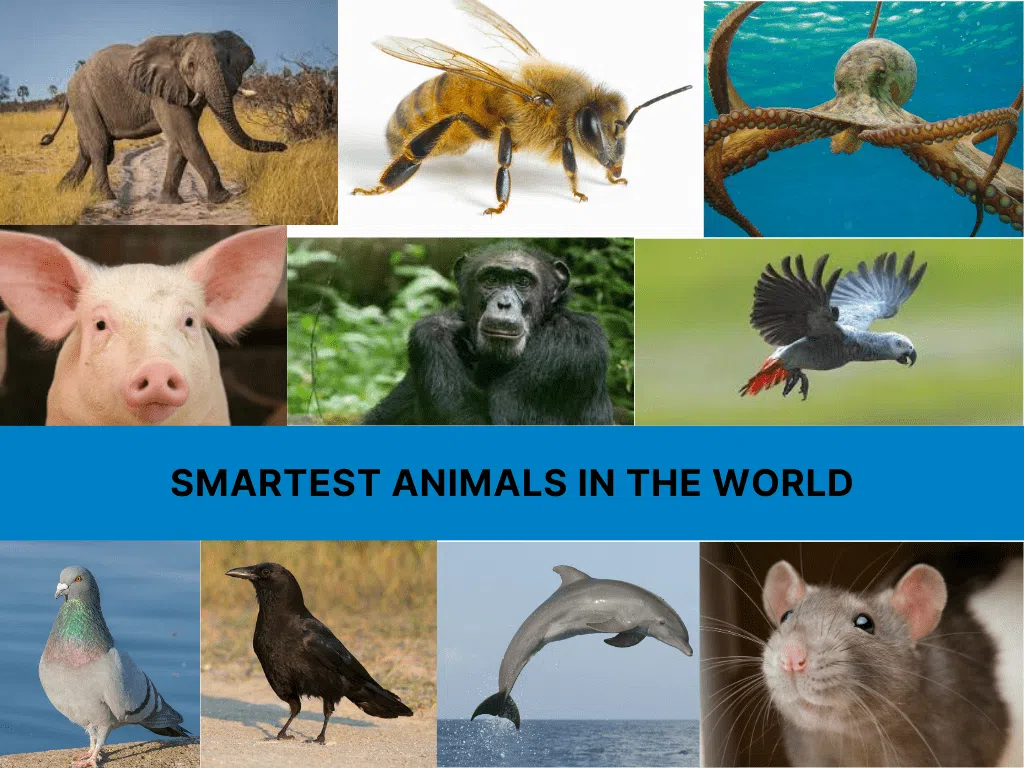
1. Шимпанзе: похожи на людей
Unsurprisingly, chimps top most lists of the smartest animals in the World. They share about 98.8% of our DNA, and studies suggest that, as in humans, genes account for a substantial part of the differences in intelligence between individual chimps (Hopkins and colleagues, Current Biology, 2014). They can learn hundreds of symbols, play with objects, and even appear to mourn their friends’ deaths. Chimps have been observed making and employing tools for simple tasks such as cracking nuts with stone hammers and fishing for termites with stripped twigs. Research at Fongoli in Senegal has even recorded chimps sharpening sticks into spears to hunt small primates called bushbabies. In memory tests at Kyoto University, a young chimp named Ayumu outperformed university students at recalling the positions of numbers flashed briefly on a screen. Different chimp communities also have different tool traditions, a simple form of culture.
2. Dolphins: Recognise Themselves and Plan Ahead
Dolphins are often ranked just behind the great apes. This is because of their large brain relative to body size, their emotional capacity, and their outstanding ability to mimic. Bottlenose dolphins recognise themselves in a mirror (Reiss and Marino, PNAS, 2001), use individual “signature whistles” that work like names, and some in Australia carry sponges on their beaks to protect them while foraging, a skill passed from mothers to calves. At the Институт исследований морских млекопитающих в Миссисипи, trainers taught dolphins to pick up rubbish in their tanks and trade it for fish, and one dolphin named Kelly found a way to scam the system. Kelly maximized her fishy prize by hiding paper under a rock in her pool and tearing single sheets into many pieces, then turning them in one at a time. Kelly’s deception appears to have been planned.
3. Crows and Ravens: Understand Cause and Effect
Crows and their relatives, the corvids, are among the smartest animals in the World. American crows recognise individual human faces and remember people who have treated them badly: in a University of Washington study, crows kept scolding researchers wearing a “dangerous” mask for years afterwards. New Caledonian crows make hooked tools from twigs and leaves, and in “Aesop’s fable” experiments crows dropped stones into water to raise the level and reach floating food, showing a basic grasp of cause and effect. Some crows have even learned the timing of city rubbish collections to snag food on bin day.
4. Elephants: Never Forget a Friend
Elephants have excellent memories and are among the smartest animals in the World. They can remember routes to watering sites across long distances and many years, and they remember companions too. Shirley, an elephant, came to the Elephant Sanctuary in Tennessee in 1999. Jenny, the resident elephant, immediately became lively and playful. It wasn’t love at first sight; Jenny recognized Shirley from their brief appearance in a circus together 22 years before. An Asian elephant called Happy at the Bronx Zoo also passed the mirror self-recognition test in 2006, a feat shared by only a handful of species.
5. African Greys: Reason Like a Young Child
Aside from mimicking people, parrots can solve puzzles using logical reasoning. In decades of work with a grey parrot named Alex, psychologist Irene Pepperberg showed that he could label objects, colours, shapes and quantities and grasp concepts such as “same” and “different”. Later experiments found that grey parrots can infer where food is hidden not just from clues to its location but also from a lack of clues, an ability once thought limited to humans and other apes. Live Science reported that these parrots reason at a level comparable to a young child. It implies that grey parrots understand cause and effect and can use it to think about the world.
6. Octopuses: Skilled Escape Artists
These tentacled organisms have repeatedly demonstrated their ability to unscrew jar lids, squeeze their bodies through tiny gaps, and crawl out of aquarium tanks to freedom. Otto, an octopus at an aquarium in Coburg, Germany, was even known to toss rocks at the glass and spray water at an overhead lamp (on more than one occasion) to short-circuit the painfully bright light. Add to it the veined octopus’s habit of carrying coconut shells to use as a portable shelter, and there’s no doubt головоногие are the most intelligent invertebrates. Remarkably, about two-thirds of an octopus’s neurons are in its arms rather than its brain.
7. Свиньи: используйте зеркала.
Pigs, like dogs, have been demonstrated to sense emotions, display empathy, solve mazes, learn simple symbols, and, most endearingly, form best friends. In a 2009 study led by Donald Broom at the University of Cambridge, young pigs given five hours to get used to a mirror then used it to find a hidden bowl of food: seven of eight found it within about 23 seconds by walking round the barrier, while pigs new to mirrors looked behind the mirror instead. A 2014 attempt by another team to repeat the experiment did not get the same result, so the finding is still debated.
8. Крысы: могут решать головоломки
Since rats are constantly used in research, you might not consider them the smartest animals in the World. But have you considered that we utilize them partly because they are intelligent and can solve the puzzles we throw at them? Even though their eyesight is significantly less sharp than ours, they can memorize complex routes. Experiments suggest rats show metacognition, knowing when they do not know the answer to a test (Foote and Crystal, Current Biology, 2007), and in a 2011 study in Наука rats repeatedly freed trapped cagemates even when they could have kept chocolate for themselves. Rats share much of their brain structure and many genes with us, which is why they are so widely used to study the human brain.
9. Голуби: могут запоминать изображения
Голуби не настолько «птичьи мозги», как вы можете себе представить, несмотря на их до смешного «неуклюжий» стиль прыжка и, казалось бы, праздный looks! In a 2006 study in PNAS, Joël Fagot and Robert Cook trained pigeons to memorise pictures, each paired with a correct response, and estimated that the birds could hold between 800 and 1,200 picture–response pairs in memory. Pigeons have also learned to tell paintings by Monet from paintings by Picasso, and to recognise all 26 letters of the alphabet.
10. Пчелы: удерживайте танцевальные позиции
Honeybees have developed “swarm intelligence,” with as many as 50,000 workers in one colony collaborating to make choices that are democratic. Colonies send out scouts to find a new home when a hive becomes overcrowded in the spring. If scouts dispute where the colony should build its next nest, they settle their differences through a dance-off. Each scout does a “виляющий танец” for other scouts to persuade them of the worthiness of her site. The more vigorous the dance, the better the scout rates her site. The rest of the scouts vote with their bodies, flying to their preferred location and joining the dance until one site wins. Individual bees are clever too: a 2018 study in Наука found that honeybees can grasp the idea of zero.
Резюме
Люди склонны переоценивать свой статус на самом высоком уровне пищевой цепи . Мы принимаем как должное, что принадлежим к числу самых развитых существ на Земле, не задаваясь вопросом, что нас отличает. Это настойчивость в поиске предметов, способность к планированию, использование инструментов или тот факт, что люди формируют сложные социальные отношения? Другие виды животных обладают некоторыми из этих черт, а некоторые — всеми. Выживание многих видов возможно только благодаря их специализированному интеллекту. Многие животные безопасно ориентируются и добывают пищу, запоминая пути и места на своей территории. Чтобы не стать добычей, некоторым приходится запоминать тактику уклонения и перехитрить хищников.
We aren’t the only clever organisms in the World, as shown by trained African giant pouched rats that sniff out tuberculosis in samples and by chimps that beat us in some memory tests. We prefer to believe that we are the smartest species on the planet, but typical classroom IQ tests only scratch the surface of an animal’s brainpower. While humans can develop sonar technology to monitor an enemy submarine, dolphins are born with it. Hence, while no animal matches human intelligence overall, some animals outperform us at specific tasks.
Читайте также : Эндемичные виды диких животных: их значение для природы в целом

0 комментариев